Underwater PhotographyUnderwater Photography
Home
Article
Category
Tag
Timeline
About
Home
Article
Category
Tag
Timeline
About
white 194brown 86blue 55black 111yellow 111pink 26transparent 33orange 62green 43purple 33red 44colorful 35brwon 50white dots 8yellow dots 6zebra 1silvery 9gray 15blue dots 12big 13tatto 12black dots 14green dots 1tiny 25green dosts 1bronw 3poisonous 2blue-border 1purple-border 1black margin 1black-dots 1color 1red dots 1yellow-rhinophores 1white-border 1purple-striped 1lightpink 1red-dot 1white striped 2leopard-print 1light pink 1
Linckialaevigata,LinckiaSeaStar

Date: 2019/12/23Category: StarFishTag: blue

蓝海星,蓝指海星

The variation (“polymorphism”, in this case, a “color morph”) most commonly found is pure, dark, or light blue, although observers find the aqua, purple, or orange variation throughout the ocean. These sea stars may grow up to 30 cm (11.8 in) in diameter, with rounded tips at each of the arms; some individuals may bear lighter or darker spots along each of their arms. Individual specimens are typically firm in texture, possessing the slightly tubular, elongated arms common to most of other members of the family Ophidiasteridae, and usually possessing short, yellowish tube feet. An inhabitant of coral reefs and sea grass beds, this species is relatively common and is typically found in sparse density throughout its range. Blue stars live subtidally, or sometimes intertidally, on fine (sand) or hard substrata and move relatively slowly (mean locomotion rate of 8.1 cm/min).
Fromia monilis,Necklace Starfish,Peppermint Sea Star

Date: 2019/12/23Category: StarFishTag: orange, blue, white

珠海星、单链蛇星、 珠链单鳃海星

Fromia monilis can reach a diameter of about 30 centimetres (12 in). Tips of the arms and the disc center of this starfish are bright red, while the remaining parts are paler, forming large plates.

The appearance of this sea star can be highly variable (colors, plates, presence of plates on the central disc, armpits…), and its identification using picture can be difficult, as many other species (like Fromia nodosa) can have a very similar aspect.

Thyca crystallina,Crystalline,Seastar Snail

Date: 2020/10/1Category: SnailTag: blue

百里香,蓝晶笠瓷螺

Thyca crystallina is a species of sea snail, a marine gastropod mollusc in the family Eulimidae. It is one of nine species within the genus Thyca, all of which are parasitic on starfish in the Indo-Pacific Ocean. This species was first described in 1846 by the American conchologist Augustus Addison Gould as Pileopsis crystallina but was later transferred to Thyca.

Coriocella nigra,Network Lamellaria,Lack Velutinid

Date: 2019/12/11Category: SnailTag: black, blue

黑绒海蜗牛,黑海菇螺

The color of the body may vary from uniformly velvety black to brown. The mantle is broadly tuberculate. The borders of the mantle are delicate, notched in front and spreading out widely. The foot is small and oval. There are four or five lobes or bosses on the dorsal part of its body. There is an inhalant siphon extended in the middle of the front part of the body.The tentacles are triangular, granulated and are spotted with white.There are brown eyes at the base of the tentacles. The front part of the foot is grooved. There is a jaw and a radula with 48 teeth in the mouth. The body length is usually about 80 mm. The body length varies from 15–18 mm up to 10 cm. The width of the body is 8–10 mm (in body length 15–18 mm).

Vir philippinensis,Bubble Coral Shrimp

Date: 2019/12/15Category: ShrimpTag: transparent, blue

泡泡珊瑚虾

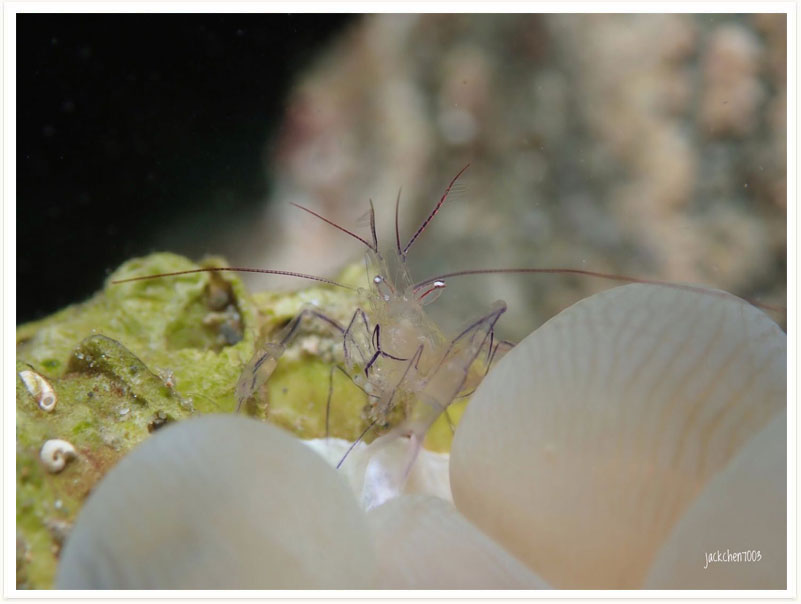
Vir philippinensis, sometimes referred to as the bubble coral shrimp, is a species of saltwater shrimp that was first described in 1984.

Vir philippinensis Vir philippinensis

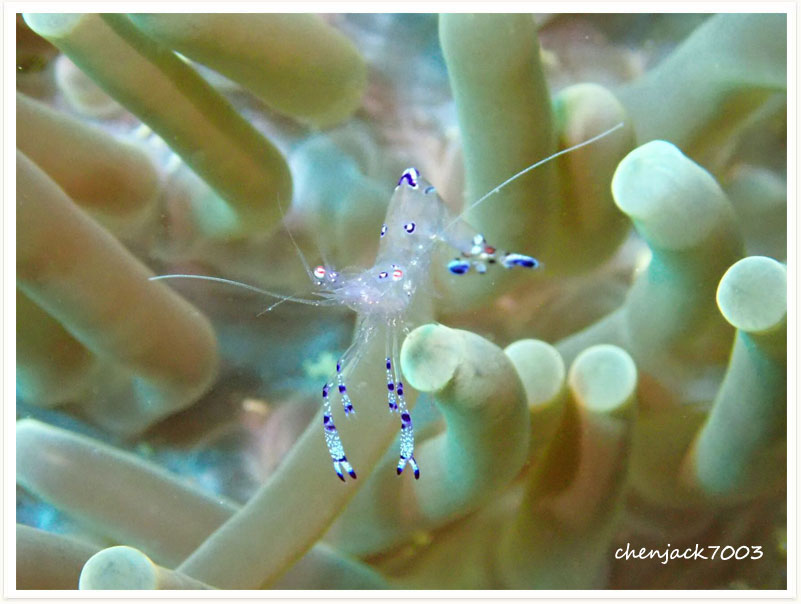
Ancylomenes sarasvati,Sarasvati Anemone Shrimp

Date: 2019/12/15Category: ShrimpTag: transparent, blue

土佐岩虾、娑罗氏伐底海葵虾

Ancylomenes sarasvati is a shrimp species from the Palaemonidae family. The scientific name of the species was first validly published in 2002 by Okuno.

Ancylomenes sarasvati

Ancylomenes magnificus,Partner Shrimp,Magnificent Shrimp

Date: 2019/12/16Category: ShrimpTag: transparent, white, blue

海葵岩虾

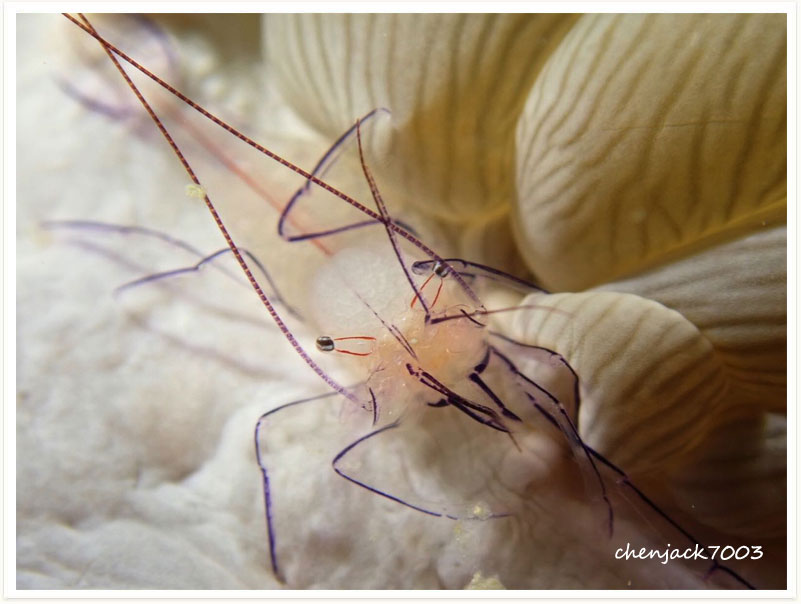
Ancylomenes magnificus, is a kind of cleaner shrimp common to the Western Pacific Ocean at depths of 3–29 metres (10–95 ft).

These shrimp are commonly found on scleractinian coral, Catalaphyllia and the anemone, Dofleinia armata. They have a transparent body except on the carapace and segments of the abdomen which have bands of white specks outlined in red. The tail and the hump on the abdomen are also white.

Ancylocaris brevicarpalis,Peacocktail Anemone Shrimp,Pacific Clown Anemone Shrimp

Date: 2019/12/16Category: ShrimpTag: transparent, white, blue, yellow

孔雀尾海葵虾、短腕岩虾

Periclimenes brevicarpalis can reach a length of 0.5 to 1.0 inch. The body is almost transparent, with some white spots over carapace and tail and orange spots outlined in black over the caudal fin. Females are larger than males and have more white spots. This species lives symbiotically with sea anemones, corals and jelly fish.

Mespilia globulus,Tuxedo Urchin

Date: 2019/12/27Category: SeaUrchinTag: blue, white

短刺礼服海胆、高腰海胆、蓝礼服海胆

It is a small regular sea urchin of almost spherical shape, whose diameter of the shell (called “test”) can go up to 5 cm1. The quills (“radioles”) are fine and fairly short, not exceeding 2 cm, densely arranged and ringed in black or brown with the white tip. These radioles are arranged in five times two well delimited bands (called “ambulacraires”), all the quills of each band being as “brushed” in the same direction. These bands alternate with ten other bands without spines (perradial and interradial bands), most often brightly colored deep blue (most often Duck blue, Klein blue, royal blue or verdigris, but sometimes also almost greenish black), and whose appearance is reminiscent of velvet. It is in fact a carpet of small denticulate globiferous pedicellars.

Diadema paucispinum,Diadema Paucispinum

Date: 2019/12/27Category: SeaUrchinTag: black, blue

长刺海胆

Diadema paucispinum is a small sea urchin with very long, moveable spines which are slender and sharply pointed. They can be up to 25 cm (10 in) long and about four times the diameter of the test. The primary spines are bluish-black in colour, often with pale bands in younger individuals. The shorter secondary ones are brittle and venomous and easily break off in the skin. There are photosensitive spots in the urchin’s epidermis and if a shadow falls on the animal, it angles its secondary spines towards the intruder. These can cause a painful sting if they come into contact with bare skin. Near the apex of the test is a clearly visible anus surrounded by an orange ring and raised on a small projection. Radiating from this are five narrow, bright blue lines.

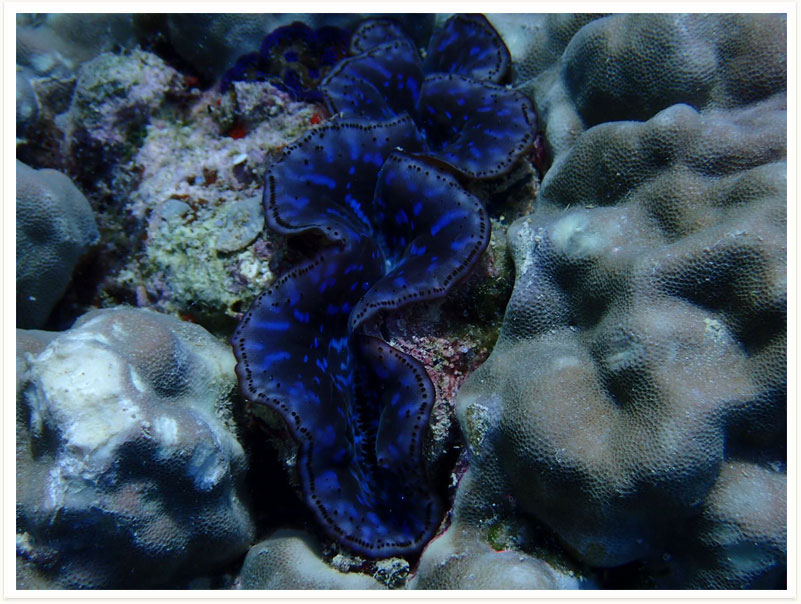
Tridacna maxima,Blue Maxima Clam,Small Giant Clam, Elongate Giant Clam

Date: 2019/12/15Category: SeaShellTag: black, blue

长砗磲

Bivalves have two valves on the mantle. These siphon water through the body to extract oxygen from the water using the gills and to feed on algae. The maxima is less than one-third the size of the true giant clam (Tridacna gigas).

Tridacna maxima

Spondylus varius,Giant variable Thorny Oyster

Date: 2019/12/24Category: SeaShellTag: blue, orange

蓝巨海菊蛤

Sphondylus varius is the largest of the spiny oysters, reaching a maximum size of about 20 cm. Aside from the size, the shell is easily recognisable because its adult part is white, but a colourful (usually crimson, but it can be yellow) prodissoconch is clearly visible at the apical end.

Stichopus chloronotus,Greenfish

Date: 2019/12/24Category: SeaCucumberTag: blue, yellow

绿刺参、方柱参、方刺参

Stichopus chloronotus is a fairly large species growing to about 25 cm (10 in) with a firm but pliable body and a squarish cross section. The skin is smooth but there are numerous conical fleshy papillae in longitudinal rows, and these are larger on the lower lateral angles. This sea cucumber is a deep blackish-green in colour, and has yellow or red tips to the papillae.

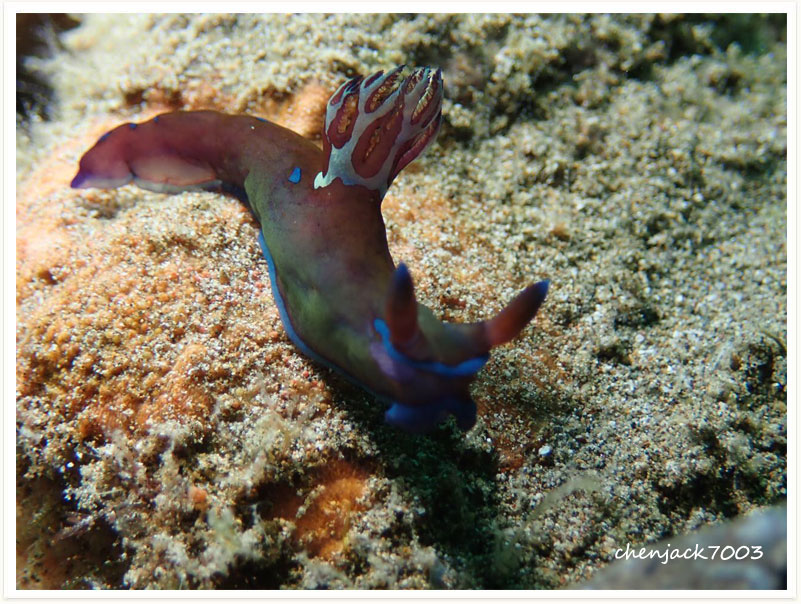
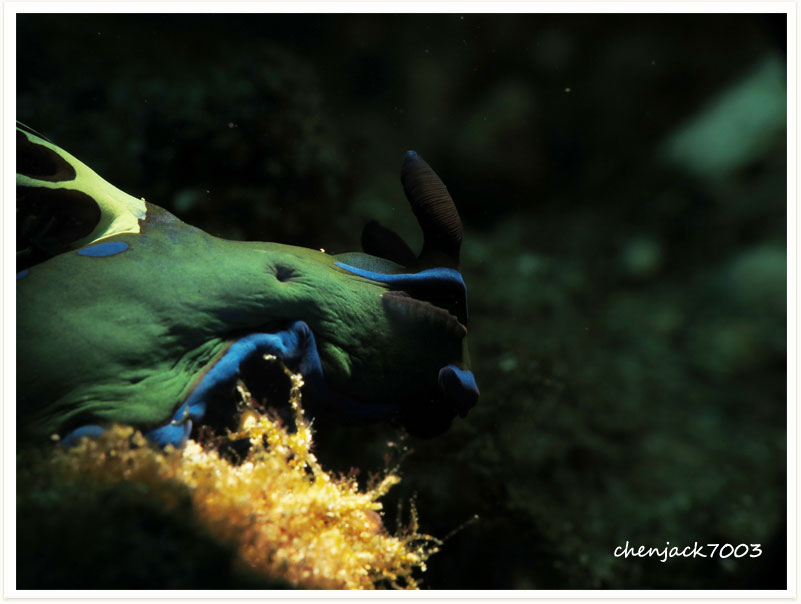
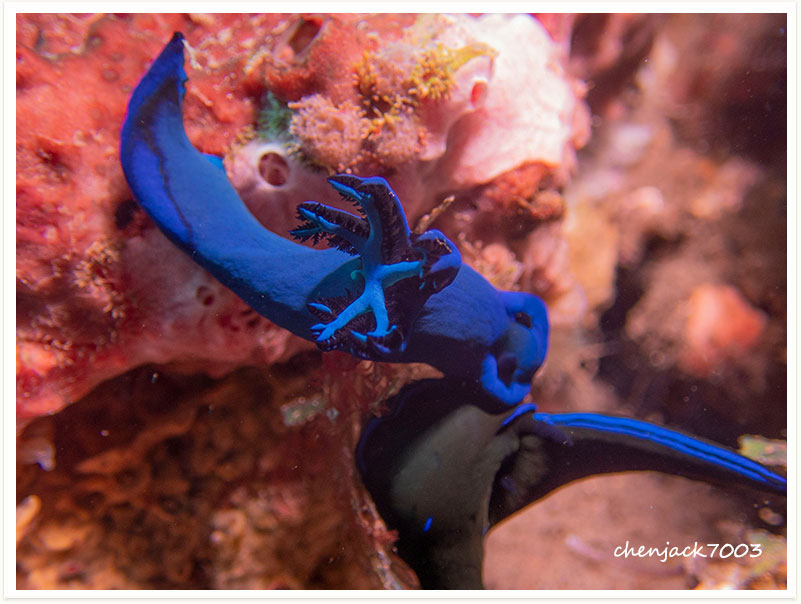
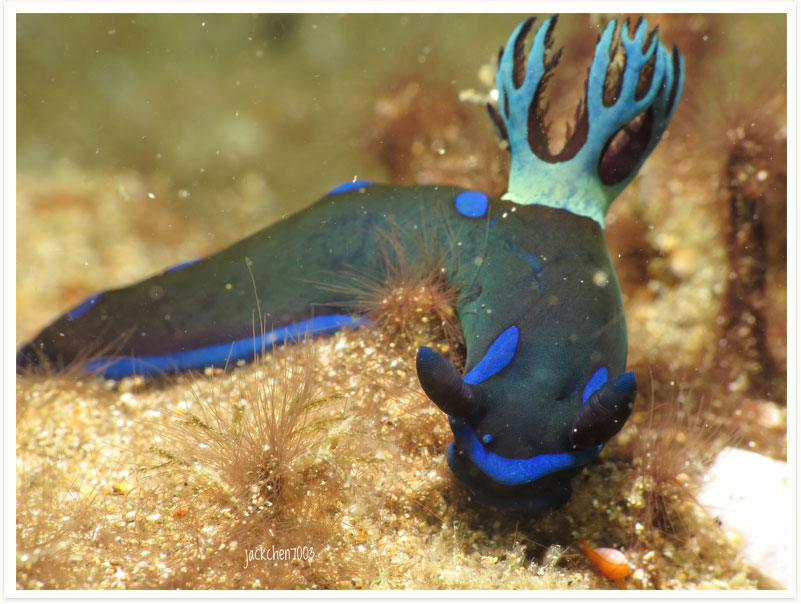
Tambja morosa,Gloomy Nudibranch

Date: 2019/12/10Category: NudibranchTag: blue, green, brown

蓝纹锈边海蛞蝓

Tambja morosa can swim by movement of the body. All Tambja species feeds on bryozoan (moss animals).

Tambja morosa Tambja morosa Tambja morosa Tambja morosa

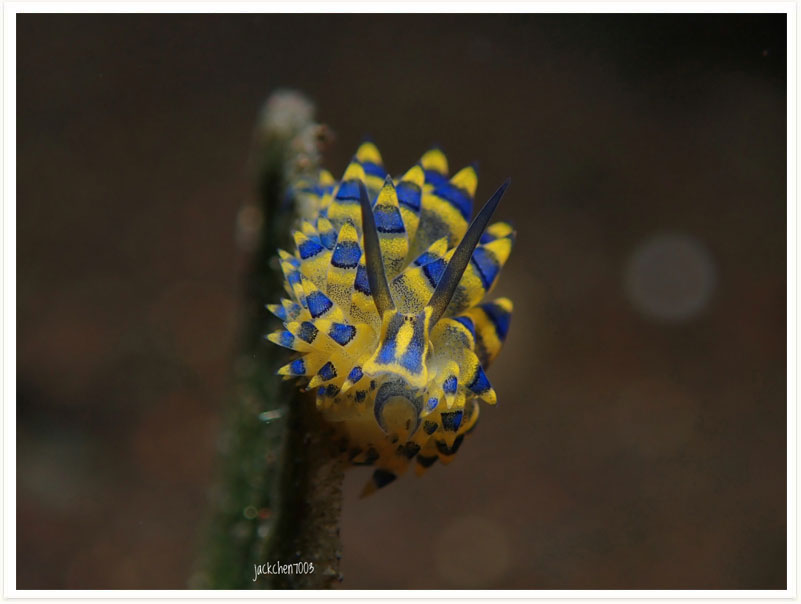
Stiliger ornatus,Sap-sucking Slug

Date: 2019/12/10Category: NudibranchTag: yellow, blue

绵羊海兔

Feed on algae such as Codium intricatum, Codium spongiosum und Codium edule.Better left in the sea.

Stiliger ornatus

Pteraeolidia ianthina,Blue Dragon Nudibranch

Date: 2019/12/9Category: NudibranchTag: blue

紫灰翼海蛞蝓、蓝龙

Pteraeolidia ianthina, one of the most common aeolids found, is often called a “blue dragon” by Eastern Australian divers because of its close resemblance to a Chinese dragon. It is one of the most common aeolid nudibranchs found in Eastern Australia, and can inflict a painful sting to humans.

Phyllidiopsis annae,Anne’s Phyllidiopsis

Date: 2019/12/10Category: NudibranchTag: blue, black

未知

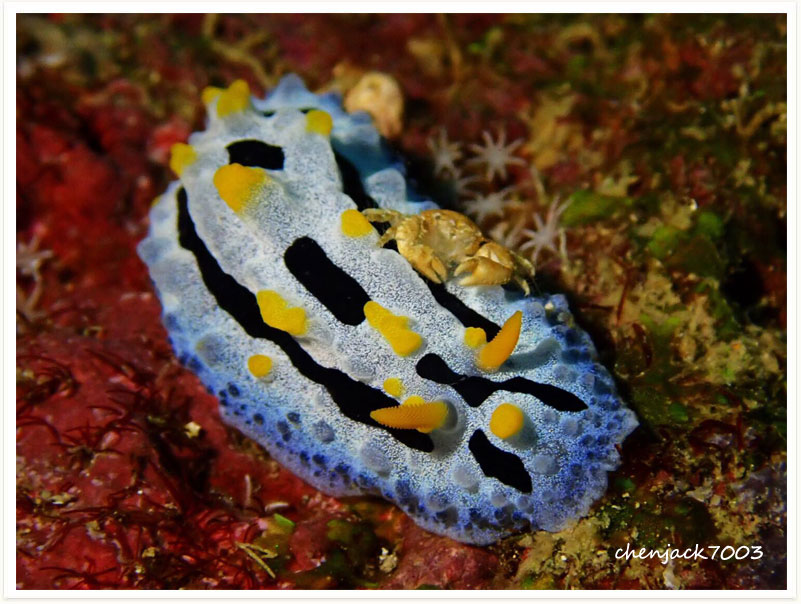
The body is a granular blue-grey with black longitunal stripes.Rhinophores are black. Phyllidiopsis annae can found to depth about 15 meters.This species feeds on sponges.

Very similar are Phyllidiopsis striata and Phyllidiopsis sphingis (differ in body colour and the colour of the rhinophores).

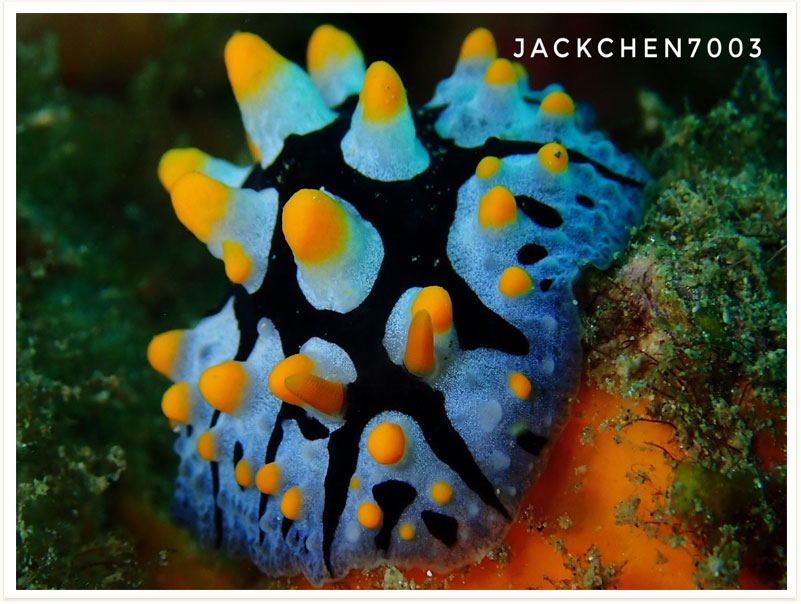
Phyllidia coelestis,Sky Blue Phyllidia

Date: 2019/12/10Category: NudibranchTag: yellow dots, blue, black

天体叶海蛞蝓

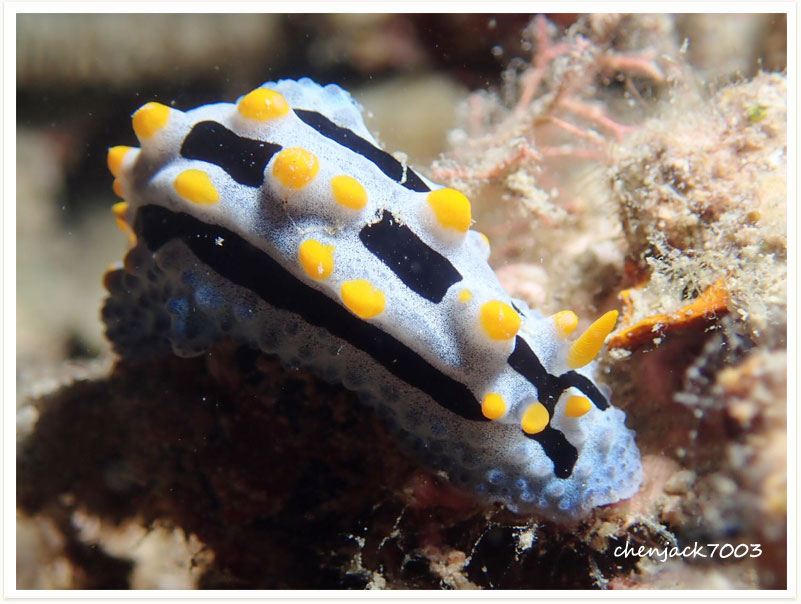
Phyllidia coelestis occours in the Indo-West Pacific, the South China Sea and the Indian Ocean to South Africa.This species can be found in lagoons and reefs up to 30 m depth.Its diurnal.Celestial Phyllidia feeds on sponges.

Phyllidia coelestis Phyllidia coelestis Phyllidia coelestis

Mexichromis trilineata

Date: 2020/3/10Category: NudibranchTag: blue, tiny

多彩海蛞蝓

Mexichromis trilineata usually ranges from 7 mm to 15 mm in length, with an elongate to broadly oval body shape. The tail extends slightly beyond the posterior margin. Mexichromis trilineata have three yellow longitudinal bands outlined in white, with the entire mantle edged with a fine white line. They have a few patches of yellow edged with white around the mantle edge, and the defensive mantle glands, arranged around the edge in roughly two series, are visible as pale pink patches. The gills and rhinophores are typically violet at their bases and then translucent white with red markings.

Hypselodoris apolegma,Giant Hypselodoris

Date: 2019/12/10Category: NudibranchTag: pink, blue, yellow, white

未知

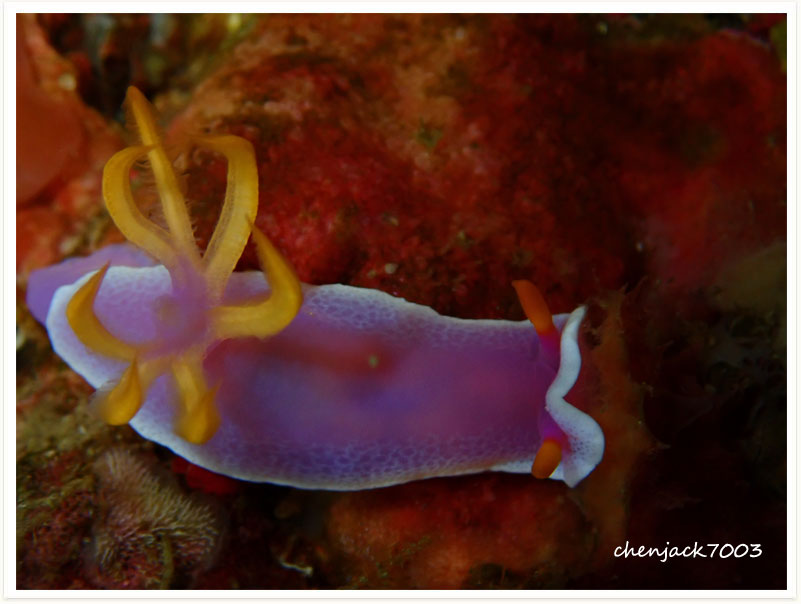
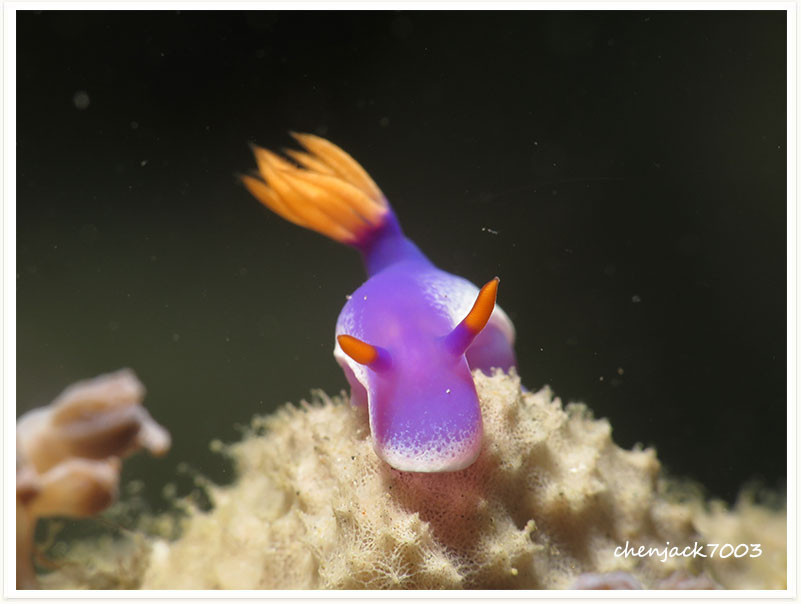
Hypselodoris apolegma (formerly classified as Risbecia apolegema)feeds on sponges (mainly genus Euryspongia)

Hypselodoris apolegma Hypselodoris apolegma Hypselodoris apolegma

Goniobranchus rufomaculatus

Date: 2020/9/30Category: NudibranchTag: blue, yellow, pink

未知

The original description included the following colour information: “Colour cream white, passing into cream yellow towards the margins, which are ornamented with a series of oblong violet spots. The central portion of the mantle is studded with numerous slightly elevated orange dots. Branchiae colourless, tentacles chocolate brown, laminae white. Under surface colourless, with the exception of a light tinge of the dorsal colours, which are transmitted through the pellucid mantle.”

Goniobranchus kuniei,Kunie’s Chromodoris

Date: 2019/12/9Category: NudibranchTag: white, blue, blue dots

铜斑多彩海蛞蝓、 昆氏多彩海蛞蝓

Goniobranchus kuniei has a pattern of blue spots with pale blue haloes on a creamy mantle. There is a double border to the mantle of purple and blue. The length of the body reaches 40 mm.The species Goniobranchus tritos and Goniobranchus geminus have similar colour patterns.

Goniobranchus albopunctatus,White-spotted Nudibranch

Date: 2019/12/10Category: NudibranchTag: white dots, pink, blue, yellow

白点海蛞蝓

The mantle is margined in yellow, dark blue and light blue, somtimes the dark and light blue are reversed. The foot is bright yellow or yellow-orange.The egg mass is peach-colored ribbon.

Goniobranchus albopunctatus

Chromodoris willani,Willan’s Chromodoris

Date: 2019/12/9Category: NudibranchTag: white, blue

威廉多彩海蛞蝓

Chromodoris willani is similar in appearance to Chromodoris lochi, Chromodoris boucheti and Chromodoris dianae. This species can be distinguished by the very prominent white specks found on the gills and rhinophores.

Individuals in this species can range in color from dark blue to a translucent white. All have black stripes with the center-most stripe typically being non-continuous

Chromodoris elisabethina,Elisabeth’s Chromodoris

Date: 2019/12/9Category: NudibranchTag: white, blue, black

伊莉莎白多彩海麒麟

Chromodoris elisabethina can reach a maximum size of 50 cm (20 in) length. The body is elongate with a foot which is distinct from the upper body by a skirt like mantle partially hiding the foot. The branched gills and the rhinophores are orange to yellow and can be withdrawn into pockets under the skin in case of danger.

Chromodoris dianae,Diana’s Chromodoris

Date: 2019/12/9Category: NudibranchTag: blue, black, black

黛安娜多彩海蛞蝓

Chromodoris dianae can reach a maximum size of 4 cm length. The body is elongate with a foot which is distinct from the upper body by a skirt like mantle partially hiding the foot. This species is very similar in appearance to Chromodoris lochi although it can be distinguished from the latter by the broken black lines, (as opposed to continuous) and the sprinkling of white specks on the notum.Chromodoris dianae has white gills and rhinophores with distinct yellow-orange tips. The original description includes animals which belong to another species (Chromodoris cf. dianae) which are distinguished by a colour pattern which includes gills and rhinophores orange throughout, orange markings at the edge of the mantle and a different pattern of black markings; confirmed as species level differences by DNA sequences

Chelidonura varians,Blue Velvet Headshield Slug

Date: 2019/12/9Category: NudibranchTag: blue, black

蓝天鹅绒海蛞蝓

This cephalaspidean is widespread in the tropical waters of the Indo-west Pacific region. Chelidonura varians feeds on flatworms and it is used in aquariums to eradicate small flat worm invasions.

Chelidonura varians

Chelidonura hirundinina,Swallotail Headshield Slug, Leech Aglaja

Date: 2019/12/10Category: NudibranchTag: blue, brown

燕尾海牛

Chelidonura hirundinina grows up to 4,0 cm in length.The body color can be red, orange, dark brown or black with blue, black and orange stripes.It has a long forked tail.This species feed on small flatworms.

Chelidonura hirundinina

Bursatella leachii,Ragged Sea Hare,Shaggy Sea Hare

Date: 2020/11/12Category: NudibranchTag: blue, brown

黄蓝斑海兔

Bursatella leachii is green to greenish brown. It has a broad and short head. Its mantle is covered with papillae (finger-like outgrowths), which give it a thorny aspect. The mantle has a network-like pattern with blue eyespots (ocelli) in black spots and green areas. It moves slowly on a broad foot. There is short, sharp tail. The short parapodia (fleshy, winglike outgrowths) are fused on their rear end.

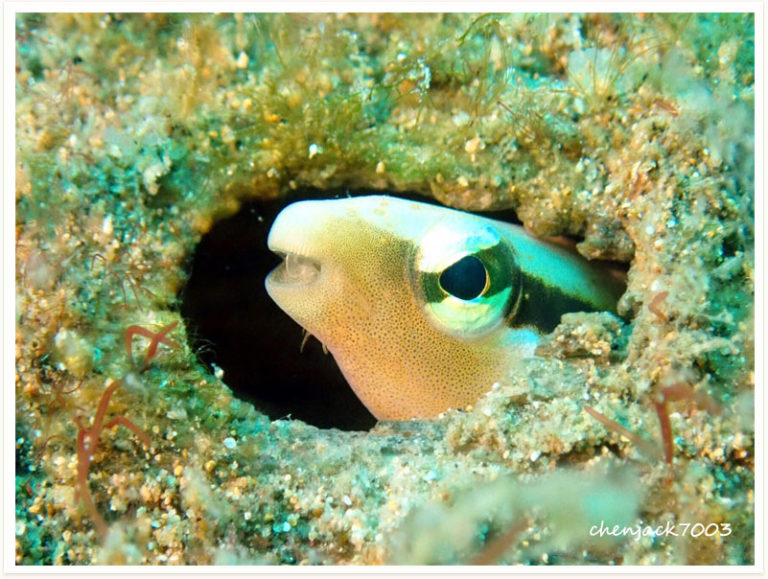
Rhinomuraena quaesita,Ribbon Moray Eel

Date: 2019/12/23Category: MorayEelTag: blue, black, yellow

安汶彩带鳗、 黑身管鼻鯙、 大口管鼻鯙、 五彩鳗

The ribbon eel (Rhinomuraena quaesita), also known as the leaf-nosed moray eel or bernis eel, is a species of moray eel, the only member of the genus Rhinomuraena. What is now known as R. quaesita also includes the former R. amboinensis. R. quaesita was used for blue ribbon eels and R. amboinensis for black ribbon eels, but these are now recognized as the same species. The ribbon eel is found in lagoons and reefs in the Indo-Pacific ocean, ranging from East Africa to southern Japan, Australia and French Polynesia. This species is widely distributed and is frequently seen by divers in Indonesian waters with their heads and anterior bodies protruding from crevices in sand and rubble habitats from very shallow to about 60 m. Although generally placed in the moray eel family Muraenidae, it has several distinctive features leading some to place it in its own family, Rhinomuraenidae.

Pomacanthus xanthometopon,Blue-face Angelfish

Date: 2019/12/25Category: FishTag: green, blue, yellow

黄颅盖刺鱼,黄面神仙鱼

The yellowface angelfish grows to a maximum length of 38 centimetres (15 in) and is laterally compressed. The mouth is just above the tip of the snout. The fins are large and rounded and are yellow, some edged with blue round the margins. The dorsal fin is set just in front of the caudal region, has a distinctive black eyespot at the base and has 13–14 spines and 16–18 soft rays. The anal fin has 3 spines and 16–18 soft rays. The scales are pale blue edged with yellow giving a reticulated pattern. The face is yellow with a dense network of brilliant blue lines on the bottom half and a plain yellow mask around the eyes. Juveniles are quite differently coloured with 6 vertical white bars separated by pale blue lines and a caudal fin barred in 2 shades of blue. The juveniles change colour gradually after reaching a length of 7 to 12 centimetres (2.8 to 4.7 in). This species can be confused with the queen angelfish (Holacanthus ciliaris) or the blue angelfish (Holacanthus bermudensis), but both these have a completely blue face and lack the caudal eyespot.

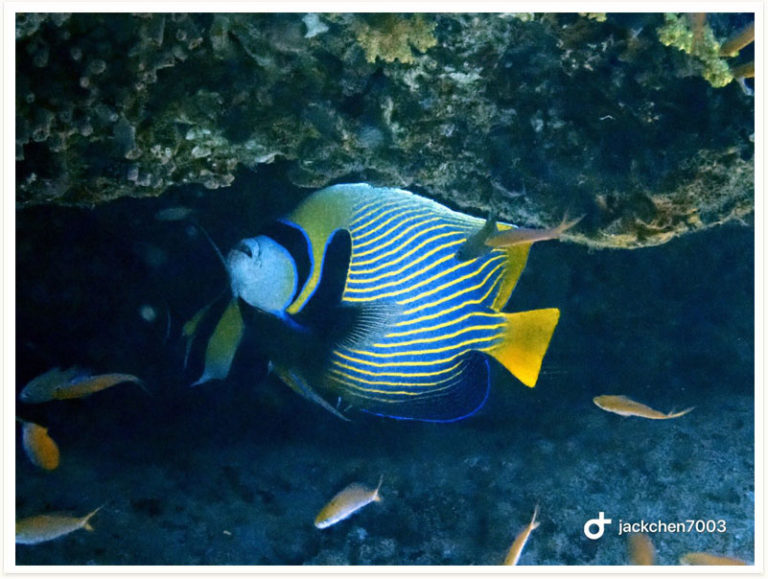
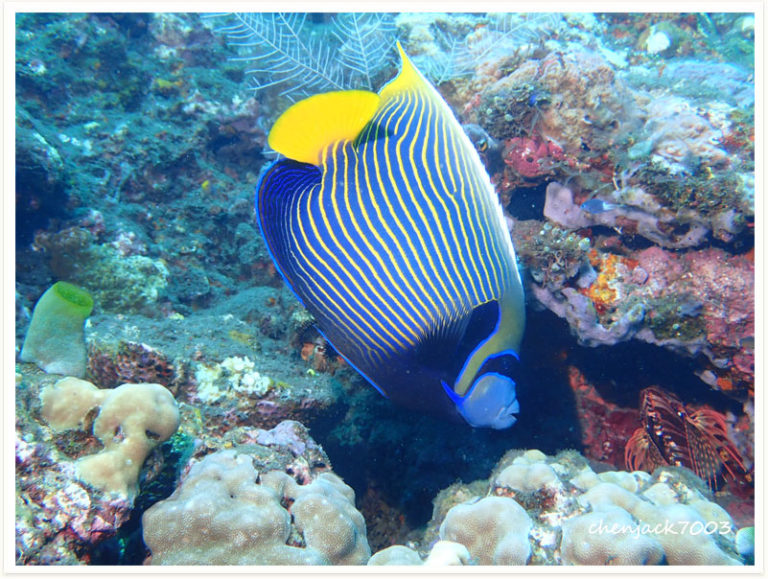
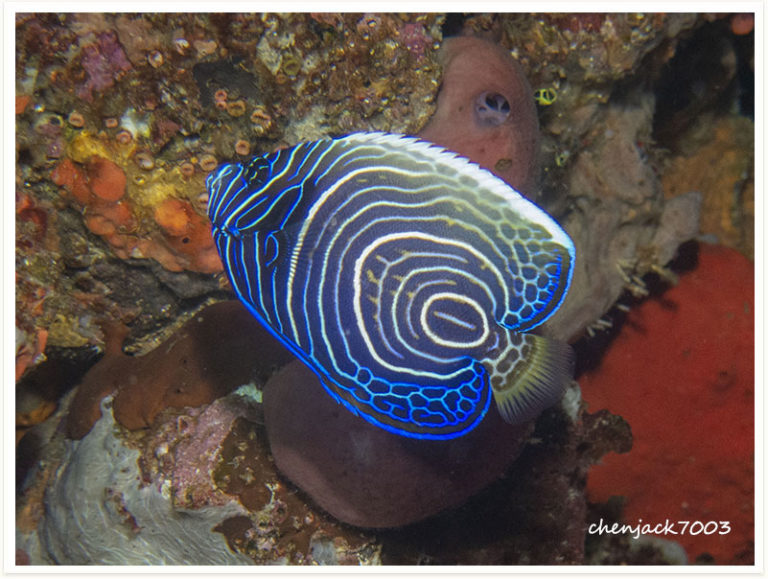
Pomacanthus imperator,Emperor Angelfish

Date: 2019/12/25Category: FishTag: blue, yellow, white, black

主刺盖鱼,皇帝神仙鱼,皇后神仙鱼

Juveniles are dark blue with electric blue and white rings; adults have yellow and blue stripes, with black around the eyes. It takes about 24 to 30 months for an emperor angelfish to acquire its adult coloring. Full adult size is about 40 cm (15.75 in) in length

Pomacanthus imperator Pomacanthus imperator Pomacanthus imperator

Ostracion meleagris,Whitespotted Boxfish

Date: 2019/12/25Category: FishTag: yellow, blue, black

米点箱鲀、白点箱鲀,花木瓜

Ostracion meleagris, the White-spotted boxfish, is a species of boxfish found in the Indian and Pacific Oceans. It is found on reefs at depths of from 1 to 30 metres (3.3 to 98.4 ft). This species grows to a length of 25 centimetres (9.8 in) TL. Males and females differ in colour: males are blackish on the back with white spots, and have bluish sides with bright yellowish bands and spots. Females and juveniles are dark brown to blackish with white spots

Ostorhinchus aureus,Ring-tailed Cardinalfish

Date: 2020/1/20Category: FishTag: orange, pink, blue

黄天竺鲷 、 环天竺鲷、环尾天竺鲷,大目侧仔

This fish is coppery-coloured with a broad blackish bar at the base of the tail, up to 14.5 cm in length. The upper jaw has a narrow blue streak, and a broad blackish stripe extends from the front of the snout to the eye. Easily confused with Ostorhinchus fleurieu, where the black tail bar does not narrow in the centre, but unlike this species, the stripe is also present in juveniles.

Odonus niger,Redtoothed Triggerfish

Date: 2020/8/3Category: FishTag: blue, green, yellow

红牙鳞鲀、魔鬼炮弹、红牙板机鲀

Redtoothed triggerfish are normally deep purple with bluish-green markings on their heads and glowing light blue margins on the tail lobes and fins. Just like other fish in the family Balistidae, the tail is lyre-shaped. The mouth of the triggerfish seems to be grinning and it maintains tiny red teeth that are needle sharp with two teeth in the upper jaw which can be seen when its mouth is closed. These triggerfish are one of the more peaceful triggers in the family but can become threatening with age and can perform a grunting-type sound. They have the ability to change their colour depending on their mood, food, feeding and water quality from purple to blue and to bluish-green.

Hydrophis belcheri,Faint-banded Seasnake

Date: 2019/12/26Category: FishTag: blue, black, poisonous

贝尔彻海蛇

The belcher’s sea snake is of moderate size, ranging from 0.5 to 1 meter (about 20–40 inches) in adult length. Its thin body is usually chrome yellowish in colour with dark greenish crossbands. The dorsal pattern does not extend onto the venter. The head is short and has bands of the same colours. Its mouth is very small but suitable for aquatic life. Its body, when viewed out of water, appears to have a faint yellow colour. Its scales are different from most other snakes in that they overlap each other. Each dorsal scale has a central tubercle. The body is strongly laterally compressed posteriorly. The ventral scales are very narrow, only slightly wider than the dorsal scales.

Hapalochlaena lunulata, Greater Blue-ringed Octopus

Date: 2019/12/26Category: FishTag: blue, brown, poisonous

蓝环章鱼

The greater blue-ringed octopus is, despite its vernacular name, a small octopus whose size does not exceed 10 centimeters, arms included, for an average weight of 80 grams. Its common name comes from the relatively large size of its blue rings (7 to 8 millimeters in diameter), which are larger than those of other members of the genus and help to distinguish this type of octopus.The head is slightly flattened dorsoventrally and finished in a tip. Its eight arms are short.

Eurypegasus draconis,Dwarf Seamoth, Little Dragonfish, Short Dragonfish, Short Seamoth

Date: 2019/12/25Category: FishTag: blue

海蛾鱼、海蛾鱼

The little dragonfish or short dragonfish (Eurypegasus draconis) is a species of marine fish in the family Pegasidae. It is widespread throughout the tropical waters of the Indo-Pacific, including the Red Sea.

The little dragonfish can grow up to 10 cm (3.9 in) length. It sheds its skin in one piece. Millions of these kind of fish are sold for traditional medicine each year in China and Hong Kong alone.

Ecsenius namiyei,Black comb-tooth, Namiye’s Combtooth Blenny

Date: 2019/12/26Category: FishTag: blue, black

纳氏异齿鳚、红尾无须鳚、红尾异齿鳚

Ecsenius namiyei, commonly called black comb-tooth blenny or Namiye’s coralblenny, is a species of marine fish in the family Blenniidae. The specific name honours the Japanese zoologist and museum curator Motoyoshi Namiye (1854-1915).

The black comb-tooth is widespread throughout the tropical waters of the western Pacific Ocean from the Philippines to Solomon Islands.

Doryrhamphus excisus,Bluestripe Pipefish

Date: 2020/9/26Category: FishTag: blue, yellow

黑胶海龙

The species is distinguished by its bluish mid-lateral stripe contrasting an orange or reddish body. Furthermore, it has a fan-like tail. A caudal fin is present, which is rounded with a white outline, the inside mostly black.The fish’s snout is elongated.

Males and females of the species grow to an average of 7 cm. A male will have a series of bumps and hooks on the upper surface of its snout, while a female will have a smooth snout. Males mature around lengths of 31 mm.

Dascyllus trimaculatus, Threespot dascyllus

Date: 2020/4/14Category: FishTag: blue, black

三斑宅泥鱼、三斑圆雀鲷、厚壳仔、三点白

The threespot dascyllus (Dascyllus trimaculatus), also known as the domino damsel or simply domino, is a species of damselfish from the family Pomacentridae. It is native to the Indo-Pacific from the Red Sea and East Africa, to the Pitcairn Islands, southern Japan, and Australia. Its grey to black body has two lateral white spots and one between the eyes like domino hence the name; the threespot dascyllus grows up to 13 cm in length. Coloration is somewhat variable; the spot on the forehead may be absent and the lateral spots very much reduced. It feeds on algae, copepods and other planktonic crustaceans.

Centropyge bicolor,Bicolor Angelfish

Date: 2019/12/26Category: FishTag: blue, yellow

二色刺尻鱼,二色棘蝶鱼,石美人、双色神仙、黄鹂神仙

The bicolor angelfish (Centropyge bicolor) is a marine species of fish, easily recognizable by its yellow tail, yellow front half of their body, and blue rear with blue patterns above and around the eye. This angelfish is also commonly known as: Pacific rock beauty, oriole angelfish, oriole dwarf angel, blue and gold angel, and two-colored angel. The average life expectancy is 5–13 years, depending upon its location. These fish tend to grow to a maximum of 6 inches in length, making them a dwarf fish.

Caranx melampygus,Bluefin Trevally

Date: 2019/12/25Category: FishTag: white, blue, silvery

蓝鳍鲹、黑尻鲹、黄臂鲹,甘仔鱼

The bluefin trevally is a large fish, growing to a maximum known length of 117 cm and a weight of 43.5 kg, however it is rare at lengths greater than 80 cm. It is similar in shape to a number of other large jacks and trevallies, having an oblong, compressed body with the dorsal profile slightly more convex than the ventral profile, particularly anteriorly. This slight convexity leads to the species having a much more pointed snout than most other members of Caranx. The dorsal fin is in two parts, the first consisting of 8 spines and the second of 1 spine followed by 21 to 24 soft rays. The anal fin consists of 2 anteriorly detached spines followed by 1 spine and 17 to 20 soft rays.The pelvic fins contain 1 spine and 20 soft rays.The caudal fin is strongly forked, and the pectoral fins are falcate, being longer than the length of the head. The lateral line has a pronounced and moderately long anterior arch, with the curved section intersecting the straight section below the lobe of the second dorsal fin. The curved section of the lateral line contains 55-70 scales while the straight section contains 0 to 10 scales followed by 27 to 42 strong scutes. The chest is completely covered in scales. The upper jaw contains a series of strong outer canines with an inner band of smaller teeth, while the lower jaw contains a single row of widely spaced conical teeth. The species has 25 to 29 gill rakers in total and there are 24 vertebrae present.The eye is covered by a moderately weakly developed adipose eyelid, and the posterior extremity of the jaw is vertically under or just past the anterior margin of the eye.Despite their wide range, the only geographical variation in the species is the depth of the body in smaller specimens.

Aspidontus dussumieri,Dussumier’s Blenny, Lance Blenny

Date: 2019/12/25Category: FishTag: white, blue, brown

稻氏盾齿鳚、稻氏盾齿鳚丝尾盾齿鳚,丝尾盾齿鳚

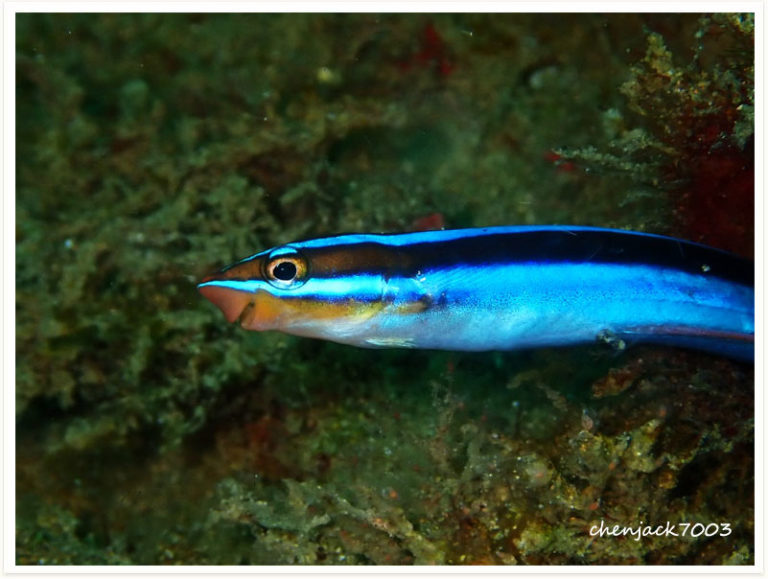
Aspidontus dussumieri, the lance blenny or Dussumier’s blenny, is a species of combtooth blenny found in coral reefs in the Pacific and Indian Oceans.The specific name honours the French explorer and merchant Jean-Jacques Dussumier (1792-1883).

Aspidontus dussumieri Aspidontus dussumieri Aspidontus dussumieri

Arothron nigropunctatus,Black Spoteed Puffer

Date: 2019/12/25Category: FishTag: white, yellow, blue, gray

黑斑叉鼻鲀、 狗头、污点河鲀

Arothron nigropunctatus is a small sized fish which grows up to 33 cm (1 ft) length. Its body is oval shape, spherical and relatively elongated. The skin is not covered with scales. The fish has no pelvic fin and no lateral line. The dorsal fin and the anal fin are small, symmetric and located at the end of the body. Its snout is short with two pairs of nostrils and its mouth is terminal with four strong teeth.

Arothron caeruleopunctatus ,Blue-spotted Puffer

Date: 2019/12/27Category: FishTag: white, blue, brown, blue dots

青斑叉鼻鲀、蓝点叉鼻鲀、气规、规仔

Arothron caeruleopunctatus is a medium-sized fish which grows up to 80 cm length. Its body is oval shape, spherical et relatively elongated. The skin is not covered with scales. The fish has no pelvic fin and no lateral line. The dorsal fin and the anal fin are small, symmetric and located at the end of the body. Its snout is short with two pairs of nostrils and its mouth is terminal with four strong teeth.

Acanthurus xanthopterus,Cuvier’s Surgeonfish, Purple Surgeonfish, Ring-tailed Surgeonfish

Date: 2019/12/25Category: FishTag: blue, yellow

黄翼刺尾鱼、黄鳍刺尾鲷、黄鳍刺尾鱼,粗皮仔

e yellowfin surgeonfish ranges in length to 70 cm (28 in). It has eight or 9 dorsal spines, 25-27 dorsal soft rays, three anal spines, 23-25 anal soft rays, and 16-24 anterior and 17-22 posterior gill rakers.

Its body is purplish gray. It has a region of dull yellow in front of its eye. The outer third of its pectoral fin is yellow, the extreme distal part is hyaline. Its dorsal and anal fins are yellowish grey basally and dull yellow distally. Its caudal fin is purplish and the caudal spine is small.

Panulirus versicolor,Painted Spiny Lobster

Date: 2019/12/17Category: LobsterTag: transparent, black, blue, white

彩绘龙虾、普通岩龙虾、竹龙虾、蓝龙虾、蓝色刺龙虾

Panulirus versicolor is a species of spiny lobster that lives in tropical reefs in the Indo-Pacific. Other names include painted rock lobster, common rock lobster, bamboo lobster, blue lobster, and blue spiny lobster. P. versicolor is one of the three most common varieties of spiny lobster in Sri Lanka, alongside Panulirus homarus and Panulirus ornatus.

Munida olivarae,Olivar’s Lobster,Bug-eyed Squat Lobster

Date: 2019/12/17Category: LobsterTag: red, yellow, blue

矮小龙虾

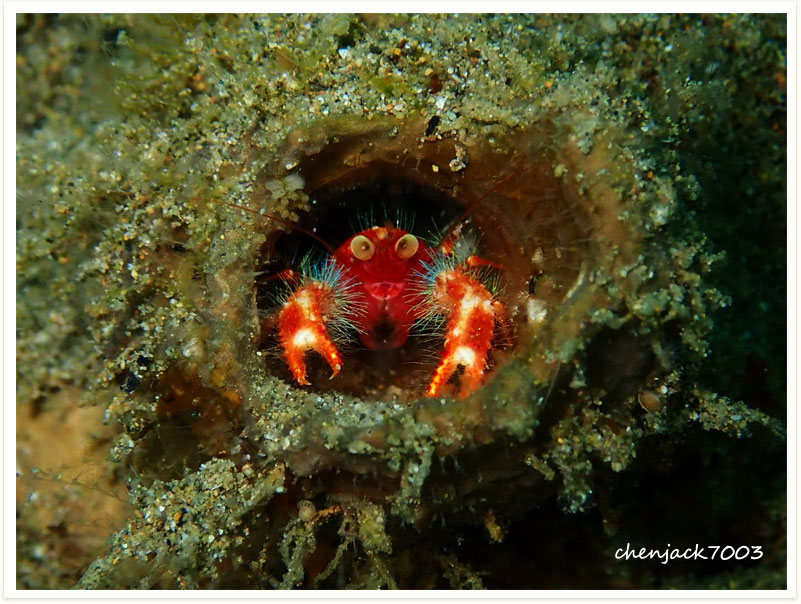
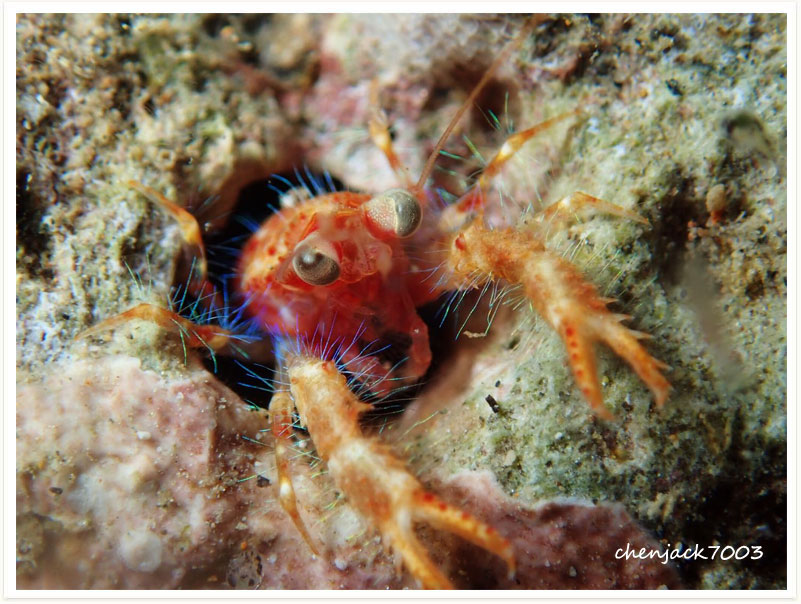
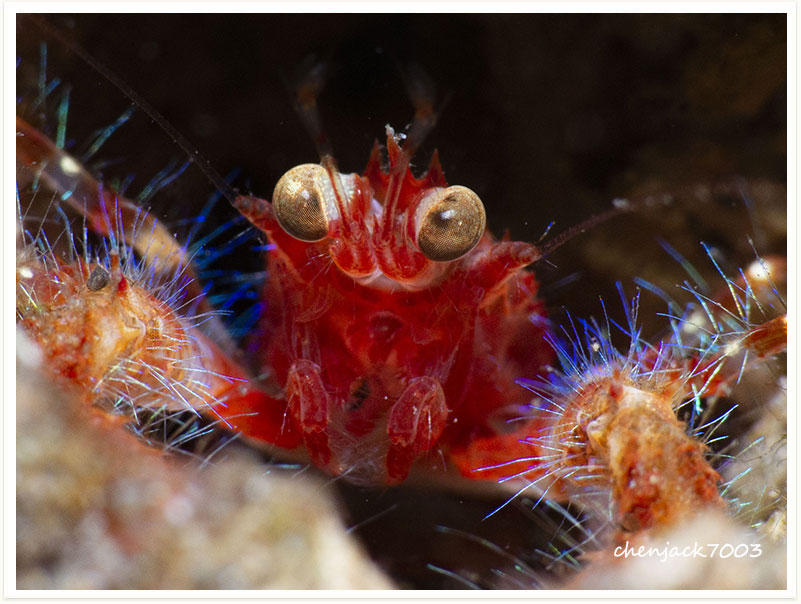
Munida olivarae is a ten-pot species from the Munididae family. The scientific name of the species was first validly published in 1994 by Macpherson.

Munida olivarae Munida olivarae ![Munida olivarae](/lobster/Munida-olivarae (1).jpg) Munida olivarae

Pseudoceros liparus,Racing-Stripes-Flatworm

Date: 2019/12/11Category: FlatWormTag: blue, purple, orange

扁虫

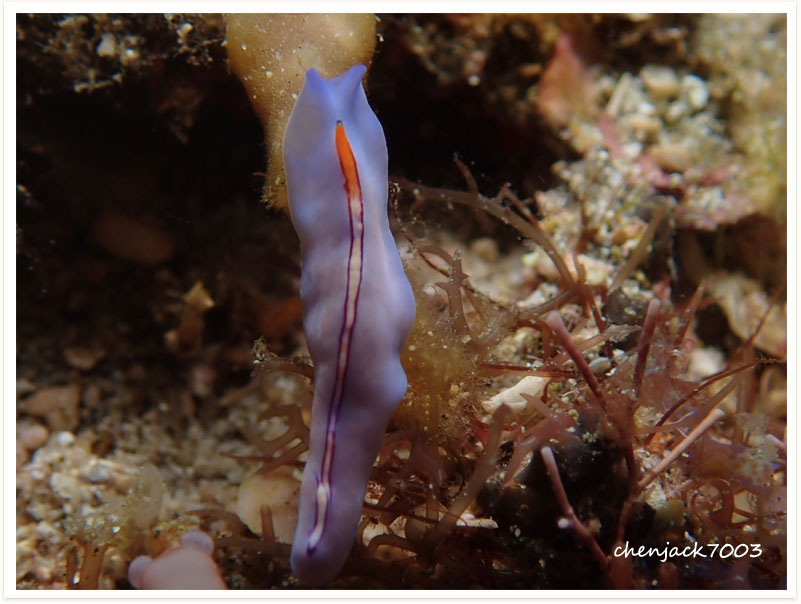
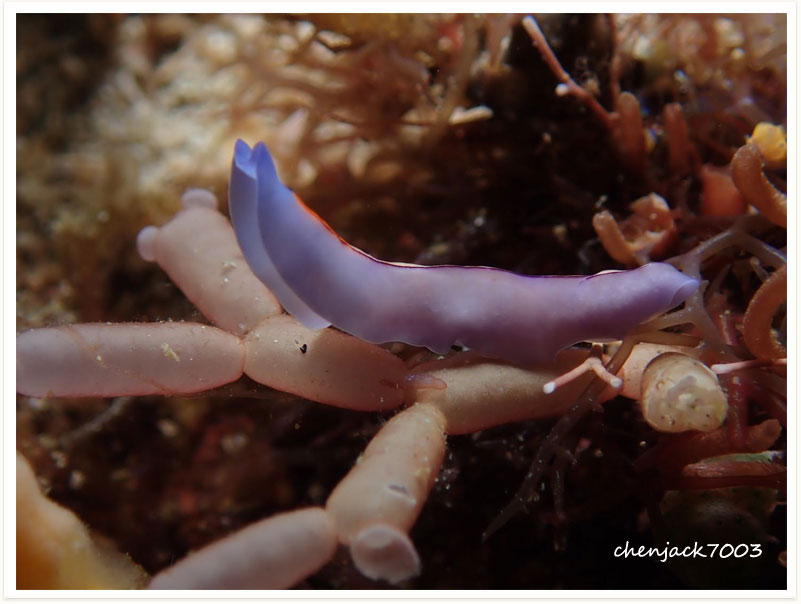
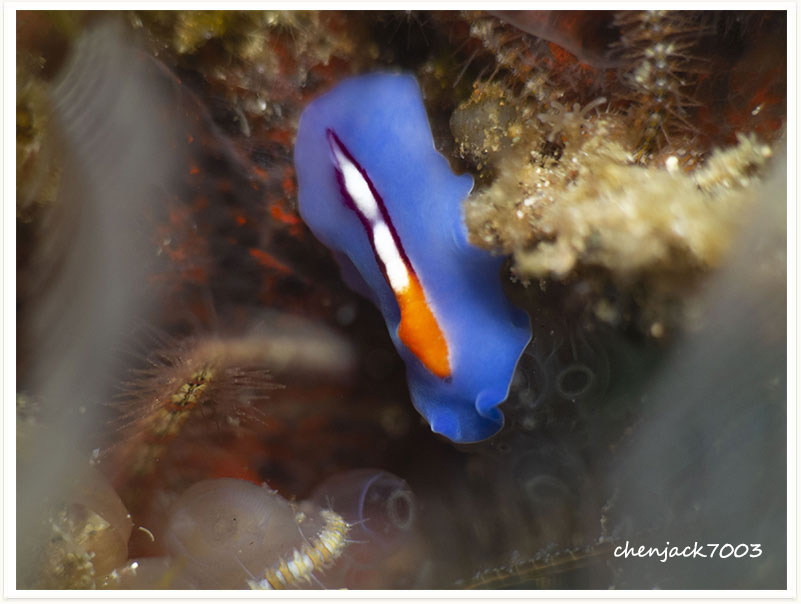
Pseudoceros is a genus of flatworms.

Pseudoceros liparus Pseudoceros liparus Pseudoceros liparus

Portunus pelagicus,Flower Crab, Blue Swimmer Crab

Date: 2019/12/17Category: CrabTag: blue, purple, white

远海梭子蟹、市仔、花脚市仔、花蟹

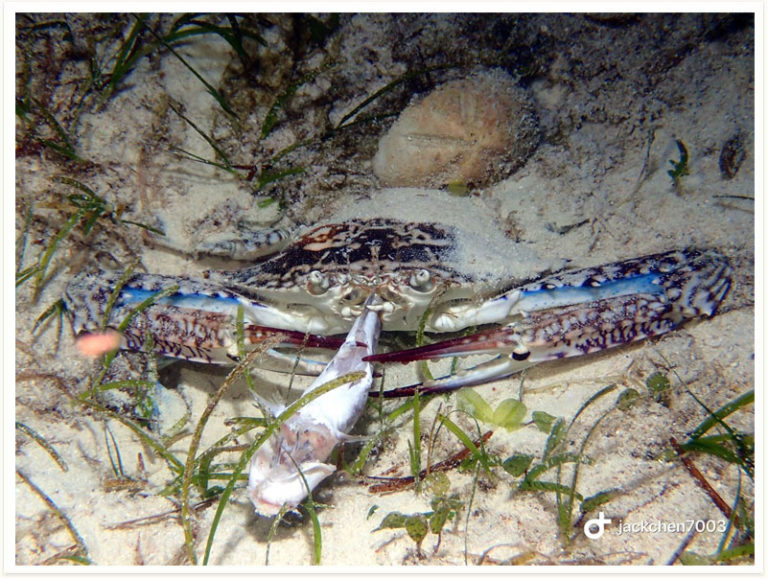
The males are bright blue in color with white spots and with characteristically long chelipeds, while the females have a duller green/brown, with a more rounded carapace. The carapace can be up to 20 centimetres (7.9 in) wide.

Portunus pelagicus

Aliaporcellana spongicola,Barrel Sponge Porcelain Crab

Date: 2019/12/17Category: CrabTag: blue, orange, black

异瓷蟹

Porcelain crabs are filter feeders. They have feather-like mouthpart appendages and eats planktonic food.

The Sponge porcelain crab Aliaporcellana spongicola shelter in groove of the large Barrel sponge Xestospongia testudinaria. This crab is commonly known as The Barrel sponge porcelain crab.

Nephtheis fascicularis,Lollipop Tunicate,Blue Palm Coral

Date: 2019/12/27Category: CoralTag: blue

棒棒糖珊瑚、蓝棕榈珊瑚

Nephtheis fascicularis, commonly called the lollipop tunicate, lollipop coral, or blue palm coral, is a species of tunicate that is native to the shallow reefs of Indonesia. It is the only species in its genus Nephtheis. They are not photosynthetic, and live on plankton and small organic particles obtained from the water currents. The branched stems are formed by tiny polyps called zooids.

Ianthella basta,Elephant Ear Sponge, Paper Sponge

Date: 2019/12/27Category: CoralTag: yellow, blue, brown

大象耳海绵

Ianthella basta, commonly known as elephant ear sponge, is a species of fan-shaped sea sponge in the class Demospongiae. It is also known as the paper sponge or scroll sponge.

Sponges are marine invertebrates with a jellylike mesohyl sandwiched between two layers of cells. They are filter feeders maintaining a flow of water through their structure which passes out through large openings called oscula. They have a fragile skeleton of stiff spicules.

Cerianthus filiformis,Tube Anemone, Large Tube Anemone

Date: 2019/12/27Category: CoralTag: blue

蕨形角海葵

C. filiformis resembles the sea anemone and has a stretched and muscularised body which can reach 35 cm. Its body has the shape of a large polyp with numerous mobile tentacles. The tint of the tentacles is variously white, green, orange or purple and the central tentacles may have a different coloration from the marginal tentacles.