Underwater PhotographyUnderwater Photography
Home
Article
Category
Tag
Timeline
About
Home
Article
Category
Tag
Timeline
About
white 194brown 86blue 55black 111yellow 111pink 26transparent 33orange 62green 43purple 33red 44colorful 35brwon 50white dots 8yellow dots 6zebra 1silvery 9gray 15blue dots 12big 13tatto 12black dots 14green dots 1tiny 25green dosts 1bronw 3poisonous 2blue-border 1purple-border 1black margin 1black-dots 1color 1red dots 1yellow-rhinophores 1white-border 1purple-striped 1lightpink 1red-dot 1white striped 2leopard-print 1light pink 1
Culcita novaeguineae,Cushion Star,Pin-Kissen Sea Star

Date: 2019/12/26Category: StarFishTag: white, black, brown, yellow

面包海星、馒头海星

A mature C. novaeguineae is pentagonal to subglobose in shape with an inflated appearance and much-abbreviated arms. It can grow to a diameter of 30 cm (12 in). Rows of tube feet are on the underside, and it has a central mouth. The colour is very variable and includes a mottling with darker and lighter shades of fawn, brown, orange, yellow and green. The armoured body wall is made of calcareous ossicles which are supported internally by pillars which buttress the ambulacra. The armouring contains pits into which the tube feet can be retracted. The body cavity is filled with water. On the dorsal face, they can be covered with small conical tubercles, as well inside as outside of papular areas.
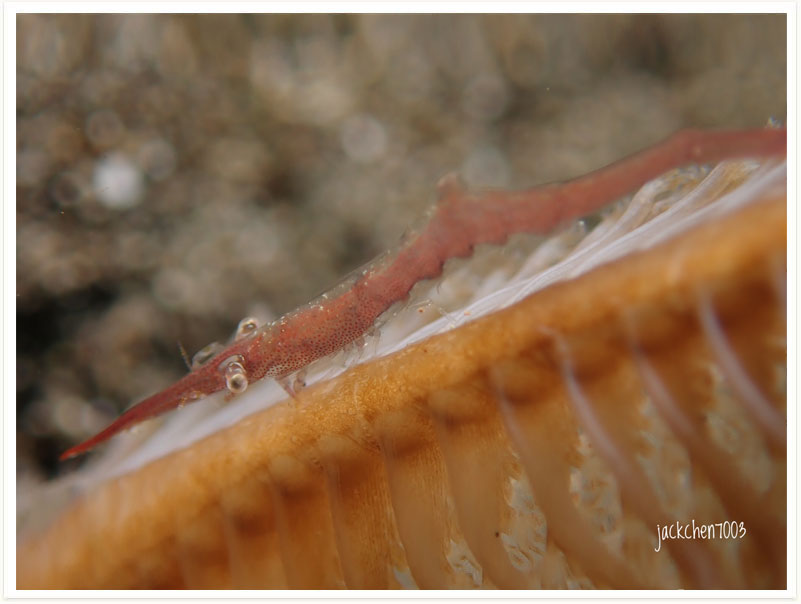
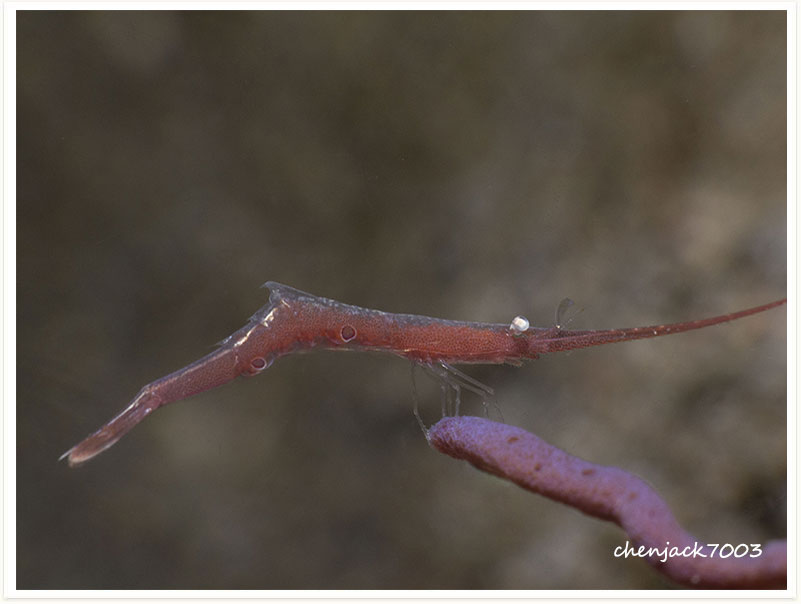
Tozeuma lanceolatum,Ocellated Tozeuma Shrimp

Date: 2019/12/15Category: ShrimpTag: brown, yellow

多赤船形虾

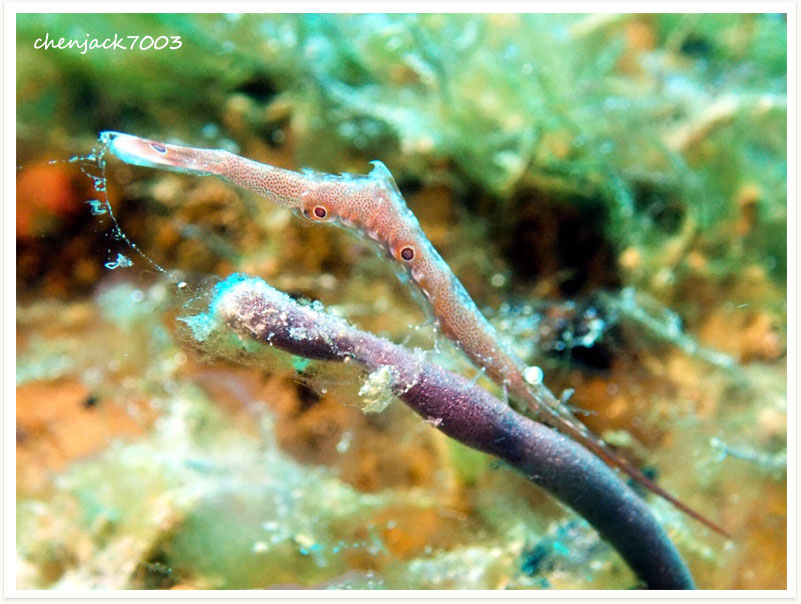
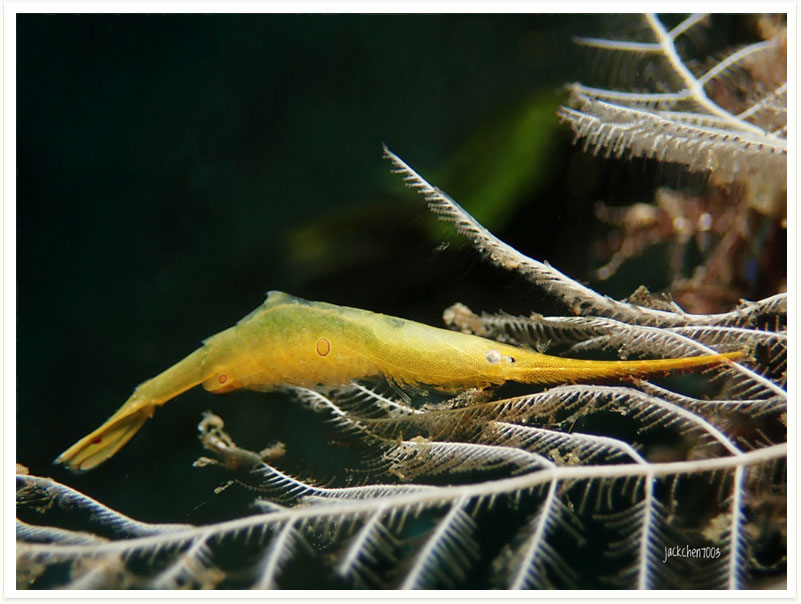
Tozeuma lanceolatum is a shrimp species from the Hippolytidae family. The scientific name of the species was first validly published in 1860 by Stimpson.

Tozeuma lanceolatum Tozeuma lanceolatum Tozeuma lanceolatum Tozeuma lanceolatum

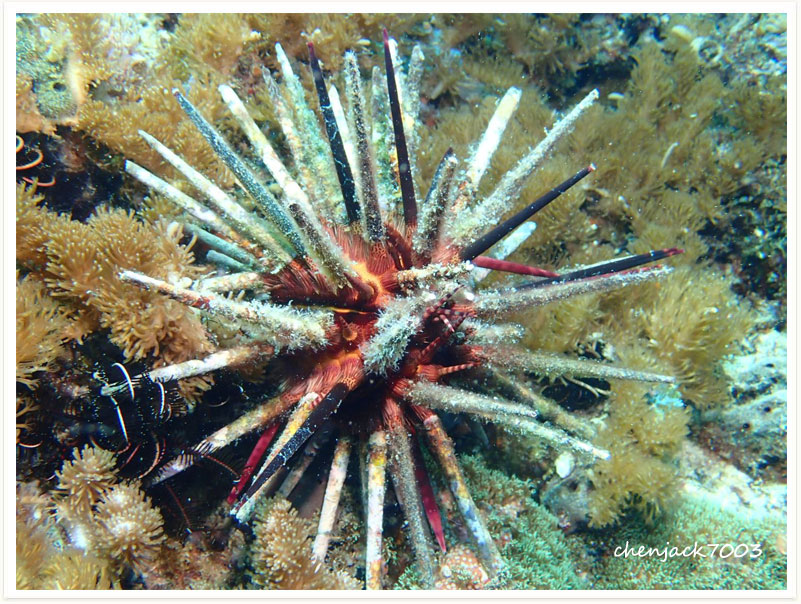
Eucidaris thouarsii,Slate Pencil Urchin

Date: 2019/12/27Category: SeaUrchinTag: white, black, red, brown

板岩铅笔海胆

Eucidaris thouarsii, the slate pencil urchin, is a species of cidaroid sea urchins that inhabits littoral regions of the East Pacific Ocean.

Eucidaris thouarsii

Pterelectroma physoides, Zebra Wingshell, Winged Oysters

Date: 2019/12/11Category: SeaShellTag: white, black, brown

牡蛎

Pterelectroma physoides, commonly known as The Zebra Wingshell, can be found attached to various marine growths, and including whip corals, hydroids, black corals and bryozoans. Pterelectroma physoides which exhibits protective coloration for lifing on alcyonarian.

Few cm in size. White background with brown lines, hence its zebra’name. This shell may easily be overlooked.

Neothyonidium magnum,Magnum Sea Cucumber,Burrowing Sea Cucumber

Date: 2019/12/24Category: SeaCucumberTag: white, black, brown

洞穴海参

Phyllophoridae is a family of sea cucumbers, marine invertebrates with elongated bodies, leathery skins and feeding tentacles.

Members of the family are characterised by a complex ring of calcareous ossicles arranged in a tube, making a mosaic pattern. The tentacles number ten to twenty-five. Some members have spindle-shaped bodies whilst others are buried in the substrate and adopt a U-shaped form.

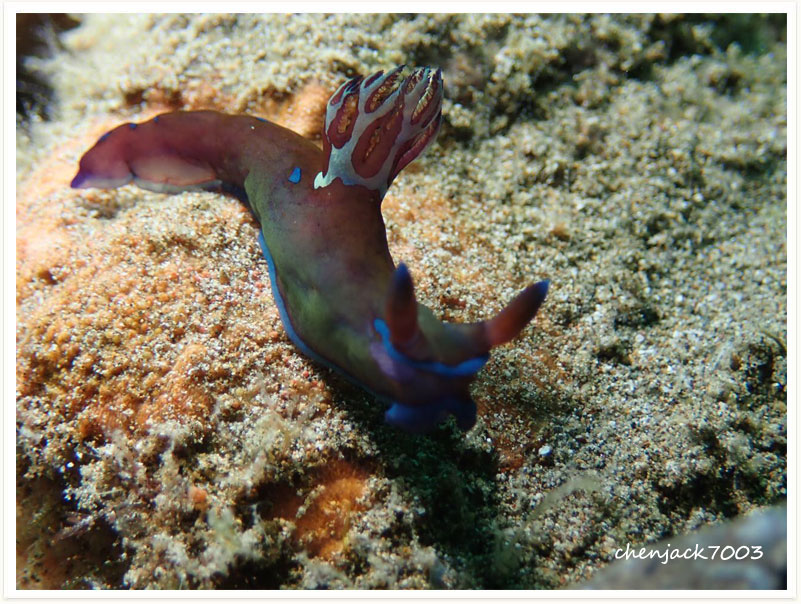
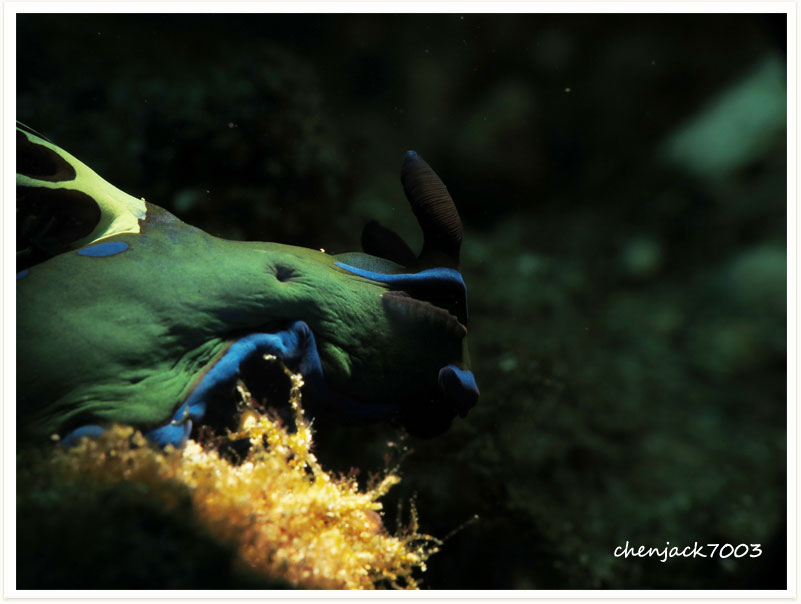
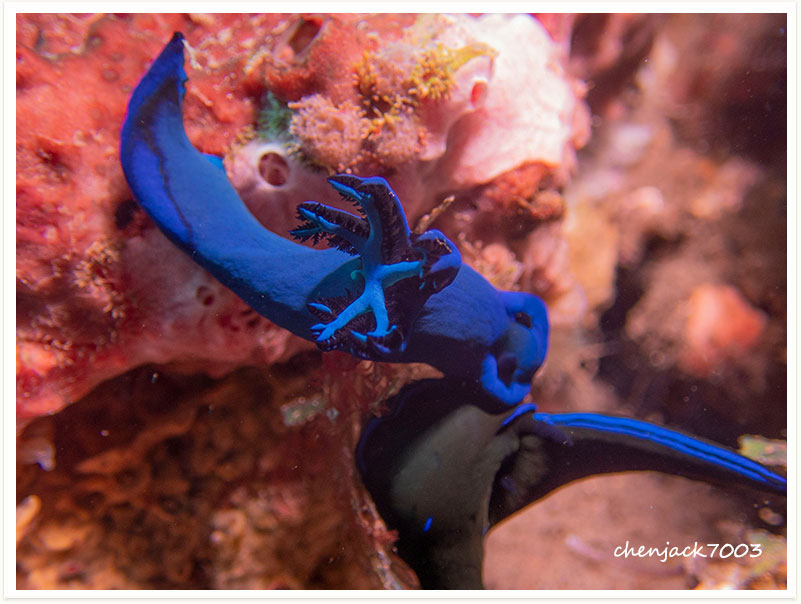
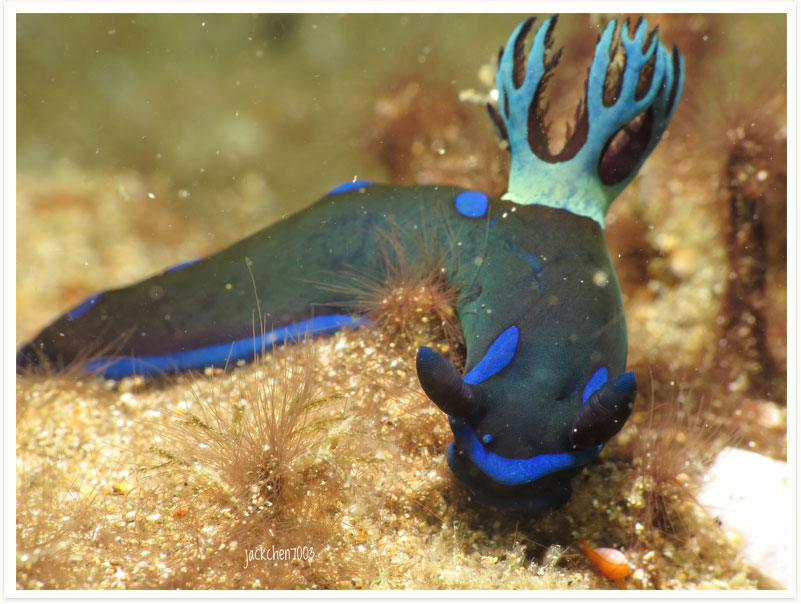
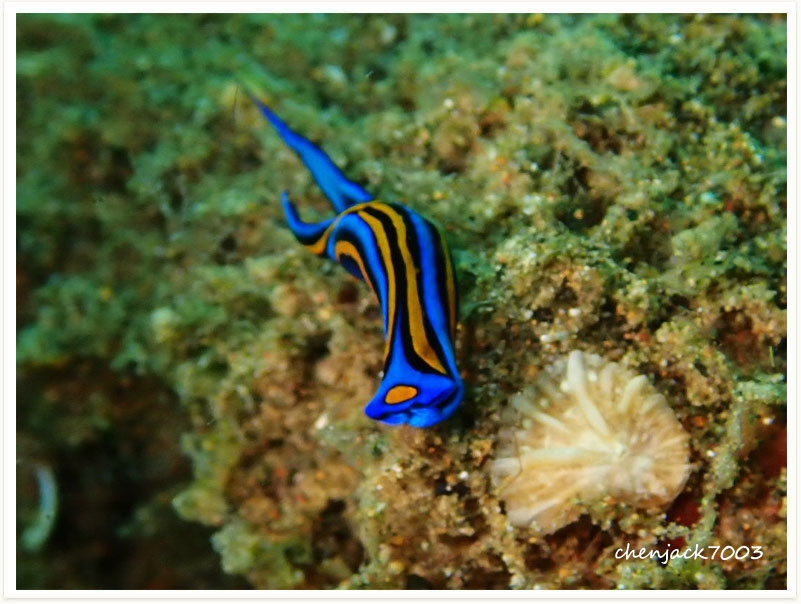
Tambja morosa,Gloomy Nudibranch

Date: 2019/12/10Category: NudibranchTag: blue, green, brown

蓝纹锈边海蛞蝓

Tambja morosa can swim by movement of the body. All Tambja species feeds on bryozoan (moss animals).

Tambja morosa Tambja morosa Tambja morosa Tambja morosa

Sebadoris nubilosa

Date: 2020/11/12Category: NudibranchTag: white, brown

未知

Sebadoris nubilosa is a species of sea slug, a dorid nudibranch, shell-less marine gastropod mollusks in the family Discodorididae.

Sebadoris nubilosa

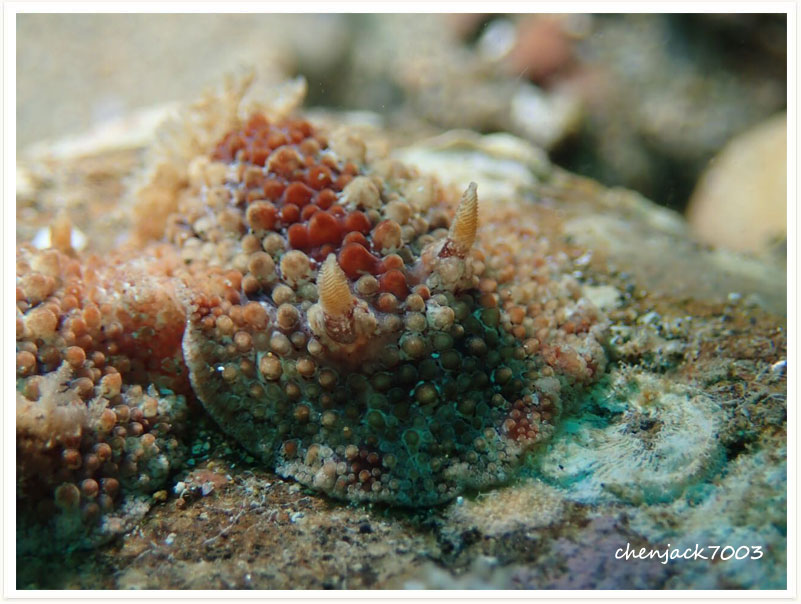
Sclerodoris tuberculata

Date: 2019/12/10Category: NudibranchTag: orange, brown

未知

The colour is a bright red, orange or grayish brown.Sclerodoris tuberculata looks have a sponge like appearance.On the body there is an excavation which mimics a sponge oscule.Sclerodoris tuberculata is a sponge eater.

Sclerodoris tuberculata

Samla bilas,Double-ringed Flabellina

Date: 2019/12/10Category: NudibranchTag: brown

双色扇羽海蛞蝓

Habitat: Tropical reefs in the Indo-West Pacific.Feed on Eudendrium hydroids.

Samla bilas

Pteraeolidia semperi

Date: 2019/12/10Category: NudibranchTag: brown, purple

紫色变翼海蛞蝓

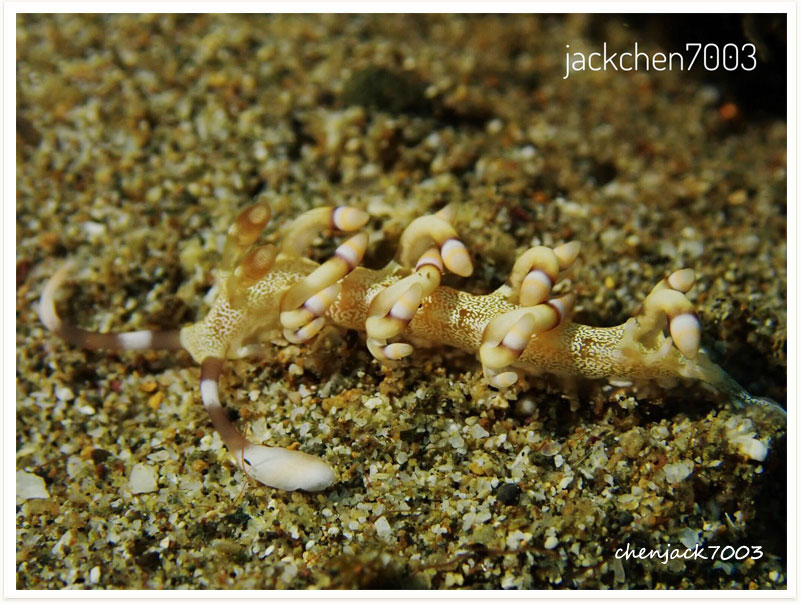
Pteraeolidia is a genus of sea slugs, aeolid nudibranchs, marine gastropod molluscs in the family Facelinidae The body color of this species is translucent tan but the cerata, which in Hawaii vary from dark purple to lavender to golden brown, give the nudibranch most of its apparent color. This is an extremely elongate species with large, curved arches of cerata along the length of the body.

Platydoris formosa,Flat Nudibranch,Flat Doris

Date: 2020/1/20Category: NudibranchTag: brown, red-dot, big

桔梗海蛞蝓

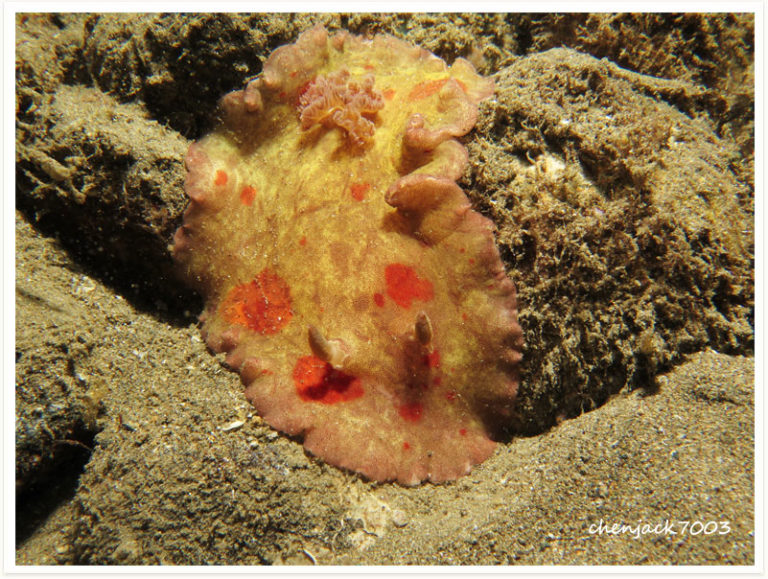
Platydoris formosa is a flat nudibranch.The body colour is yellow with unregulary and large red-orange patches.This species grows up to 18,0 cm in length. Rhinophores are yellow in colour.This flat nudibranch is nocturnal and feeds on siliceous sponges.

Platydoris formosa

Phestilla melanobrachia

Date: 2019/12/10Category: NudibranchTag: yellow, brown, tiny

黑枝背鳃海蛞蝓

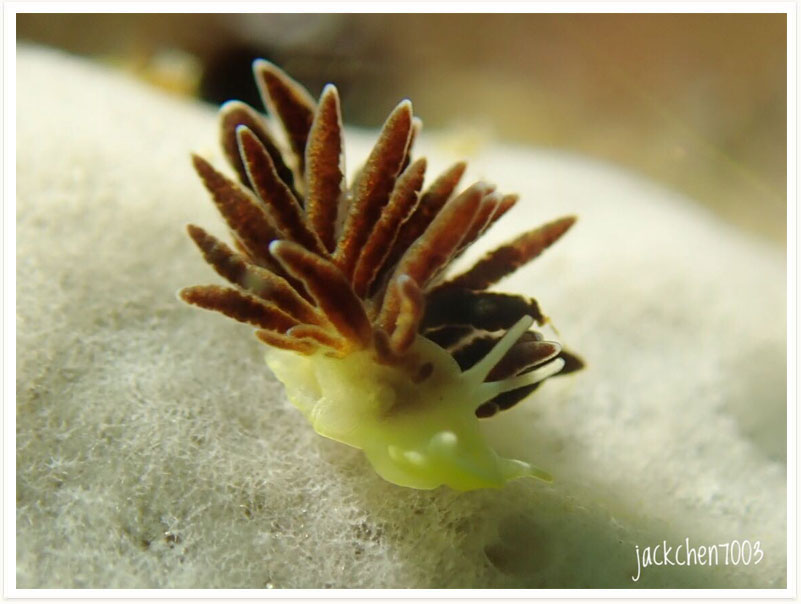
This body colour is high variable.This nudibranch is yellow,dark purple, blue, pink, brown or black. Phestilla melanobrachia feeds on Tubastraea-corals, sponges or moss animals (bryozoans).

![Phestilla melanobrachia](/nudibranch/Tenellia-melanobrachia (1).jpg) Phestilla melanobrachia

Melibe viridis,Green Melibe

Date: 2019/12/10Category: NudibranchTag: brown, big

大嘴海蛞蝓

This species lives in sea grass beds.It is very well camouflaged with their characteristic green color and their appearance. With an net-like oral veil it routs out crustaceans, which Melibe eats.Melibe viridis can grow to over 12,0 cm in length.

Melibe viridis

Melibe coralophilia

Date: 2020/10/1Category: NudibranchTag: brown

西兰花海蛞蝓

Melibe is a genus of sea slugs, nudibranchs, marine gastropod mollusks in the family Tethydidae. Most nudibranchs are carnivores, but their prey is usually sessile or slow-moving animals such as sponges or bryozoans. In contrast, Melibe is an active predator which traps fast-moving free-swimming animals such as small crustaceans, using its extendable oral hood.

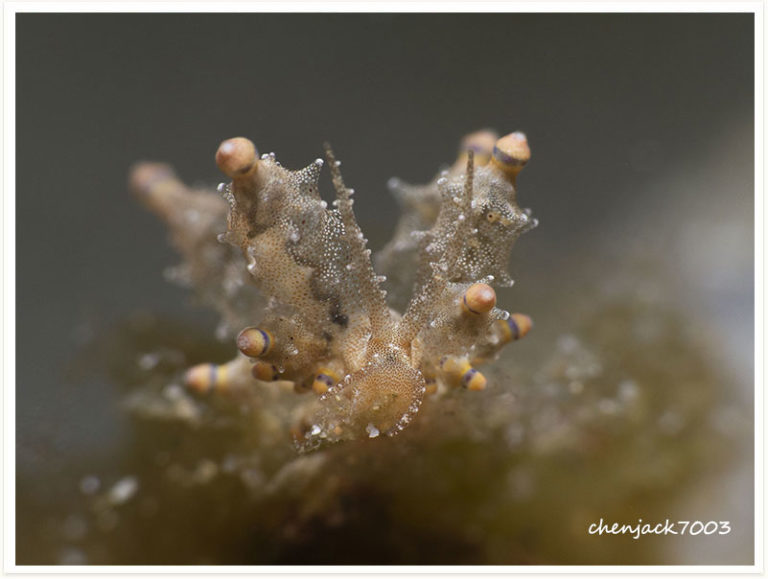
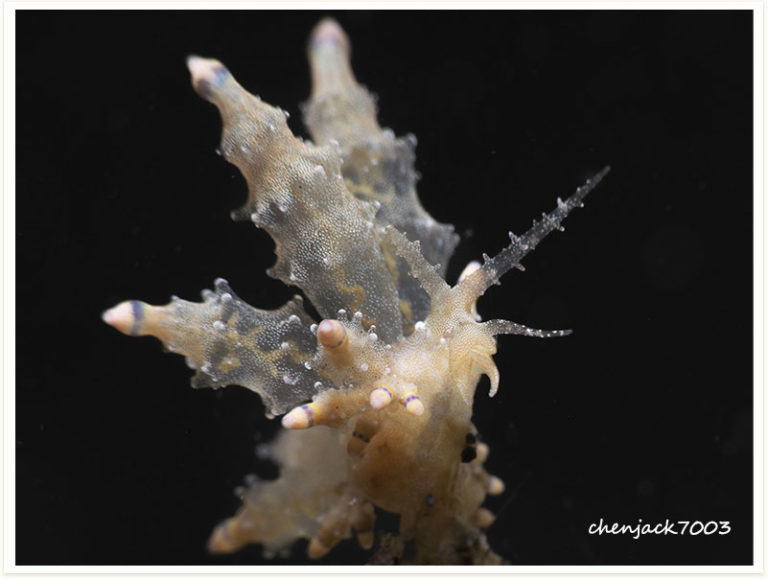
Lomanotus sp1

Date: 2019/12/10Category: NudibranchTag: brown, tiny

未知

Lomanotus sp1

Hypselodoris krakatoa,Hypselodoris Krakatoa

Date: 2019/12/10Category: NudibranchTag: yellow, brown

克雷克吐尔多彩海蛞蝓

Hypselodoris krakatoa has a pale brown-white body with black lines and white spots, a purplish-blue foot,the gills are a light-brown and rhinophores are orange-white.

This species feeds exclusively on sponges.

The name “krakatoa” refers to an Indonesian island.

Goniobranchus geometricus,Geometric Chromodoris

Date: 2019/12/9Category: NudibranchTag: white, brown, green

地母多彩海麒麟

Goniobranchus geometricus is a small nudibranch which may grow to a total length of 35mm. It is variably coloured, with the ground colour ranging from a creamy brown to purple, The mantle has numerous cream-coloured bumps and has a white margin. The gills and rhinophores are white to greenish. It is very similar to Goniobranchus conchyliatus but has green-grey rhinophores and gills whilst G. conchyliatus has red ones.

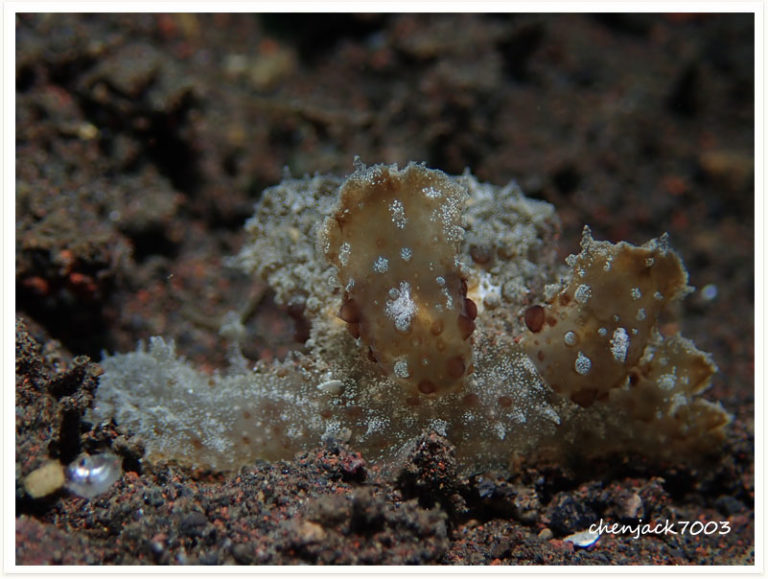
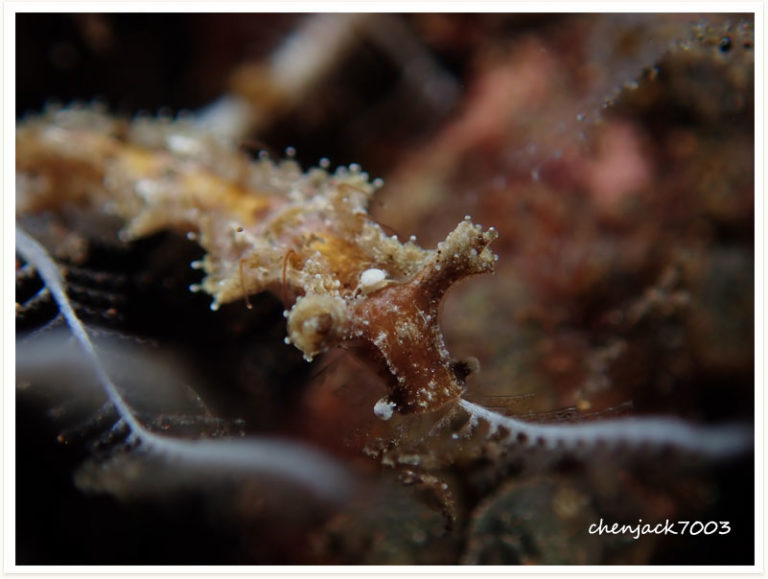
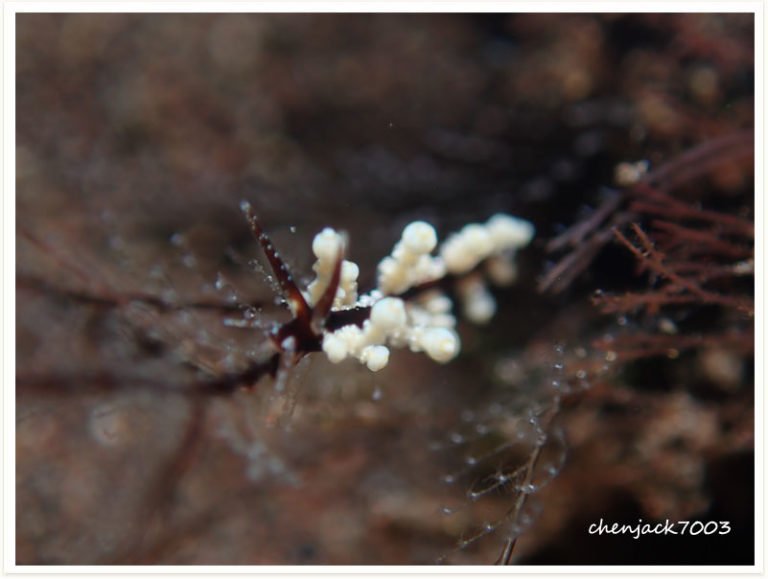
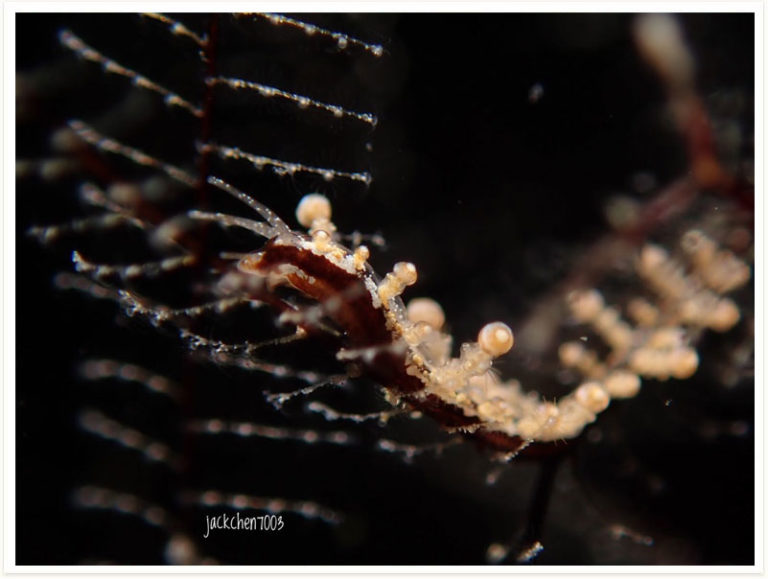
Eubranchus sp2

Date: 2019/12/10Category: NudibranchTag: white, brown, tiny

真鰓海蛞蝓

This species feeds exclusively on hydroid polpyps.Unfortunately there is no more information available and we would be grateful for any supplementary references.

This species was found in Anilao, Philippines

Eubranchus sp2 Eubranchus sp2

Eubranchus rubropunctatus

Date: 2020/7/30Category: NudibranchTag: brown

海蛞蝓

This species was described from among roots of eel grass (Cymodocea ciliata) at Oyster bay, Dar-es-Salaam, Tanzania.[1] It has been reported from Heron Island, Queensland, Australia.

Eubranchus rubropunctatus Eubranchus rubropunctatus

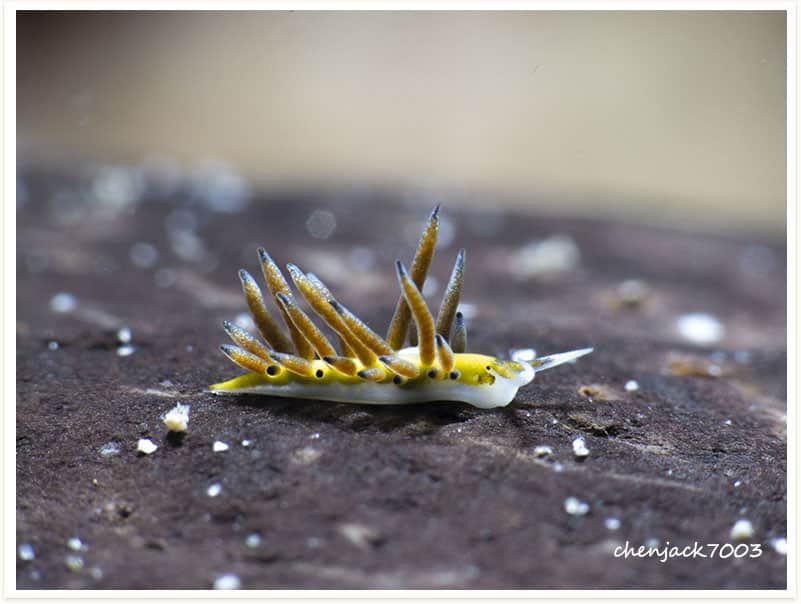
Ercolania sp1

Date: 2020/9/30Category: NudibranchTag: brown, yellow, tiny

未知

Ercolania sp1

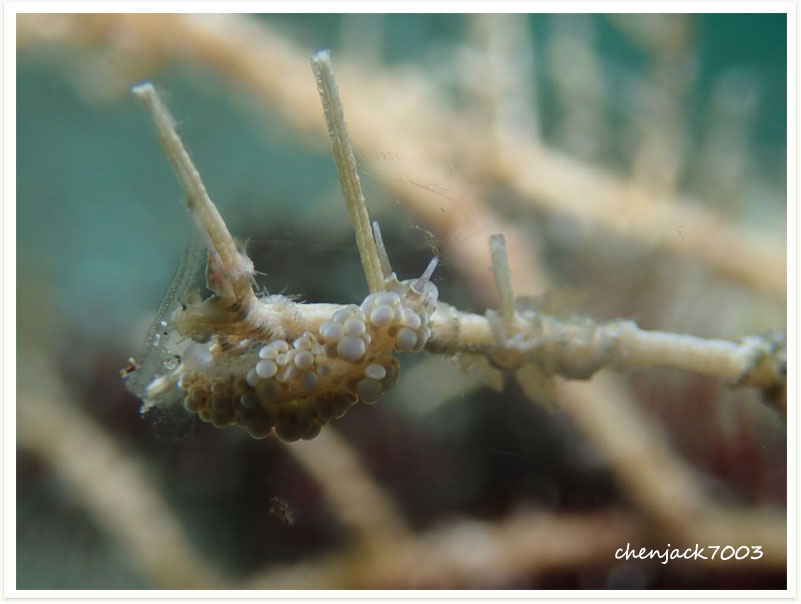
Doto sp1

Date: 2019/12/10Category: NudibranchTag: brown

未知

unkonw

Doto sp1

Dolabella auricularia,Blunt-end Sea Hare, Eared Sea Hare, Wedge Sea Hare

Date: 2019/12/10Category: NudibranchTag: big, brown

龙骨海鹿、截尾海兔、陈氏海兔

also known as the wedge sea hare, is a species of large sea slug, a marine opisthobranchgastropodmollusk in the family Aplysiidae, the sea hares

Dolabella auricularia

Discodoris boholiensis,Bohol Nudibranch

Date: 2020/9/30Category: NudibranchTag: brown, big

薄荷盘海蛞蝓

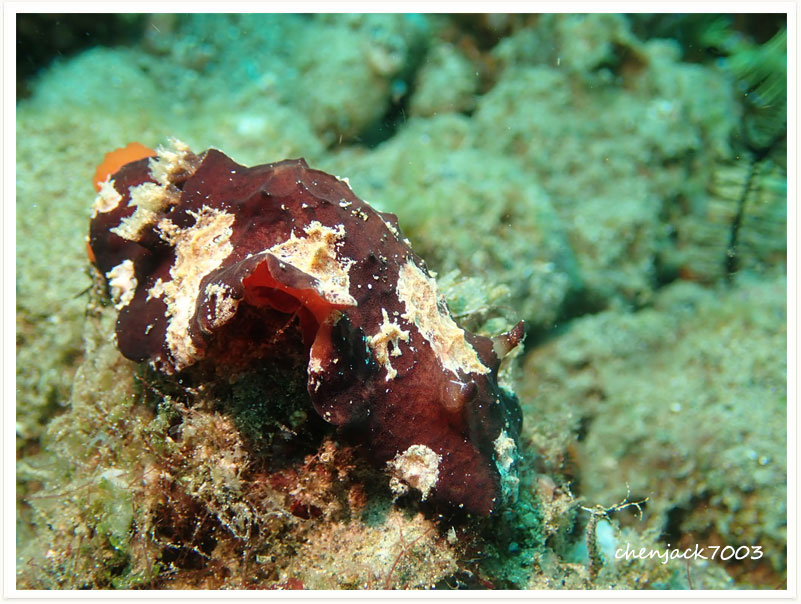
The body of Discodoris boholiensis is roughly oval-shaped, with a wavy margin, broad and rather flattened, up to 12 cm (5 in) long and 8 cm (3 in) wide. The head is not clearly demarcated from the body. The rhinophores are dark brown, with a vertical white line on the anterior surfaces, and are able to retract into their sheaths; these are also dark brown and have wavy margins. The dorsal surface of the sea slug has a thicker longitudinal ridge, the visceral hump, in the centre; it is translucent and whitish, with irregular brown patches and spots. There are six external gills, which can also be retracted, of which the hind two are divided into two branches; the gills are brown with a distinctive pattern of white lines. The edge of the mantle is undulating, leathery and semi-rigid, streaked in dark brown and creamy-white, beige or yellowish, and dotted with dark brown and white speckles. On the underside of the animal, the foot is long and oval, being much narrower than the mantle, and has a dark brown edge.

Dermatobranchus sp1

Date: 2020/9/30Category: NudibranchTag: white, brown, orange

未知

Dermatobranchus sp1

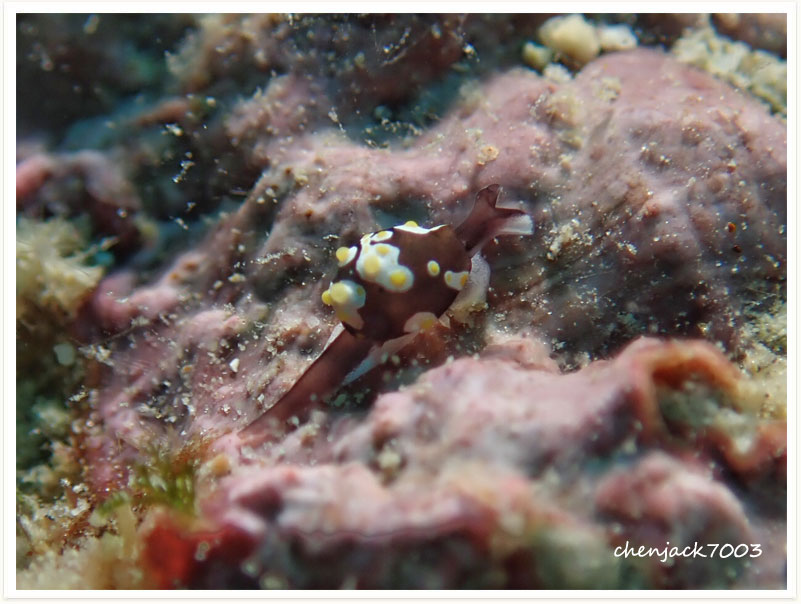
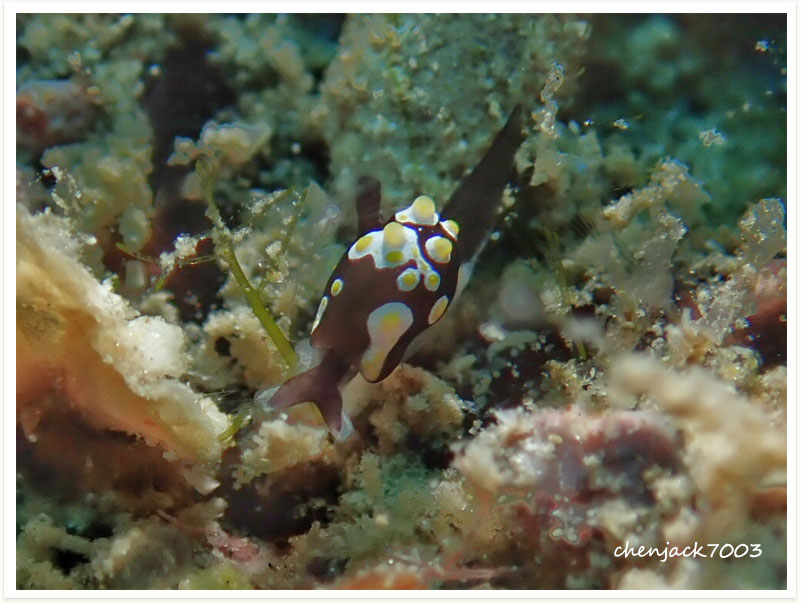
Colpodaspis thompsoni,Fried Egg Sea Slug

Date: 2019/12/10Category: NudibranchTag: brown, yellow, white

荷包蛋海蛞蝓

This tiny sea slug is black with large yellowish warts on white patches, because of that the common name is ” Fried Egg Sea Slug”. The diet is unknown.

Colpodaspis thompsoni Colpodaspis thompsoni

Chelidonura hirundinina,Swallotail Headshield Slug, Leech Aglaja

Date: 2019/12/10Category: NudibranchTag: blue, brown

燕尾海牛

Chelidonura hirundinina grows up to 4,0 cm in length.The body color can be red, orange, dark brown or black with blue, black and orange stripes.It has a long forked tail.This species feed on small flatworms.

Chelidonura hirundinina

Ceratosoma tenue,CKangaroo Nudibranch, Purple Edged Ceratosoma Nudibranch

Date: 2019/12/10Category: NudibranchTag: purple, yellow, brown

紫边多彩海蛞蝓

Ceratosoma tenue can grow to a maximal size of 12 cm length. The body colouration is extremely variable but is always composed of bright colors. However, the body colouration is not a valuable criterion of determination for this species because it can easily be confused with Ceratosoma tribolatum. The physical distinctive criteria are three mantle lobes on the first half of the body on each side and the purple margin of the mantle and foot is a dotted line. Another specificity of many species of Ceratosoma is the kind of “horn” covering the gills, which is like a lure and acts as a defensive chemical weapon that will scare any potential predator who dares to bite this part. The gills and the rhinophores are retractile in internal sheaths.

Carminodoris nodulosa

Date: 2019/12/10Category: NudibranchTag: brown

未知

unknown

Carminodoris nodulosa

Bursatella leachii,Ragged Sea Hare,Shaggy Sea Hare

Date: 2020/11/12Category: NudibranchTag: blue, brown

黄蓝斑海兔

Bursatella leachii is green to greenish brown. It has a broad and short head. Its mantle is covered with papillae (finger-like outgrowths), which give it a thorny aspect. The mantle has a network-like pattern with blue eyespots (ocelli) in black spots and green areas. It moves slowly on a broad foot. There is short, sharp tail. The short parapodia (fleshy, winglike outgrowths) are fused on their rear end.
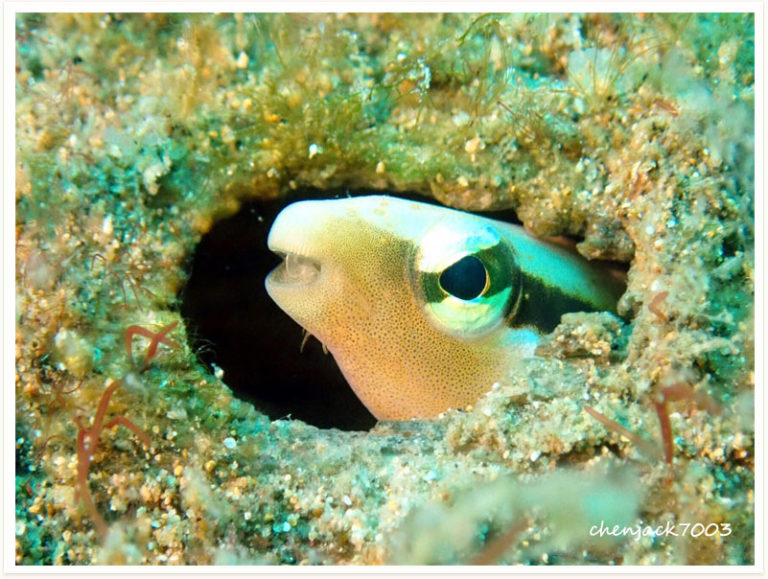
Wunderpus photogenicus,Wunderpus Octopus

Date: 2019/12/27Category: FishTag: white, brown

斑马章鱼

Wunderpus photogenicus, the wunderpus octopus is a small-bodied species of octopus with distinct white and rusty brown coloration. ‘Wunderpus’ from German “wunder” meaning ‘marvel or wonder’. Due to the appearance and behavior of the wunderpus, it is frequently confused with its close relative, the mimic octopus. The wunderpus octopus was not discovered until the 1980s and was only officially described in detail in 2006. The wunderpus octopus are important commercially to the underwater photography, dive and tourism communities, especially throughout Indonesia. The wunderpus is also valued as an expensive ornamental marine species for the home aquarium.
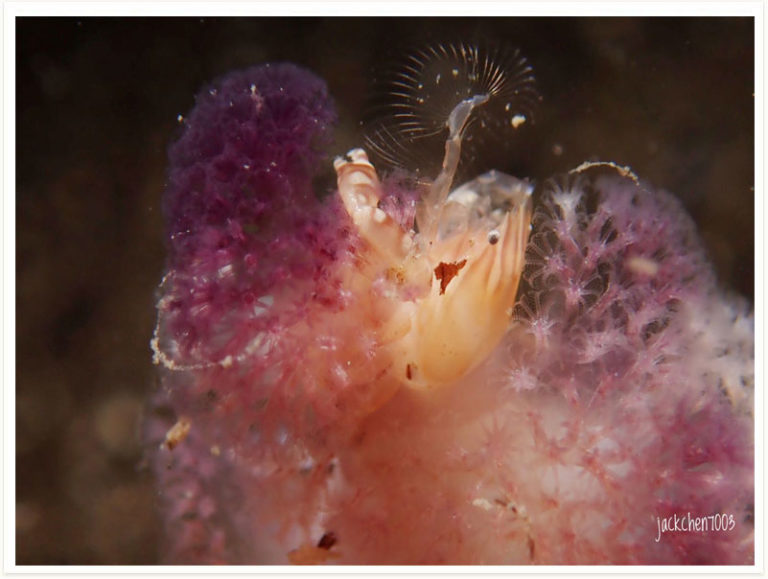
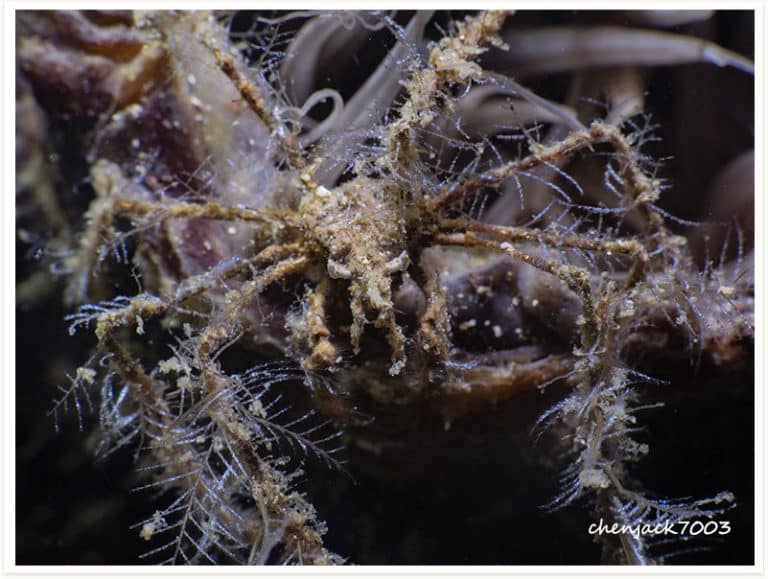
Thaumoctopus mimicus,Mimic Octopus

Date: 2019/12/27Category: FishTag: white, brown

拟态章鱼

The mimic octopus (Thaumoctopus mimicus) is an Indo-Pacific species of octopus capable of impersonating other local species. They are notable for being able to change their skin color and texture in order to blend in with their environment, such as algae-encrusted rock and nearby coral through pigment sacs known as chromatophores. The mimic octopus possesses chromatophores as well as the unique behavior of taking shape of various objects and animals. The mimic octopus is the only currently known marine animal to be able to mimic such a wide variety of animals. Many animals can imitate a different species to avoid or intimidate predators, but the mimic octopus is the only one that can imitate as diverse a range of forms in order to elude predators.

Sepia latimanus,Broadclub Cuttlefish

Date: 2019/12/26Category: FishTag: brown, white

白斑乌贼、海归墨鱼、宽腕乌贼

The broadclub cuttlefish is the second largest cuttlefish species after Sepia apama, growing to 50 cm (20 in) in mantle length and 10 kg (22 lb) in weight.Like many cephalopods, the broadclub can be seen displaying a range of colors and textures. Commonly they are light brown or yellowish with white mottled markings. Males are sometimes dark brown, particularly during courtship and mating. The arms have longitudinal white bands that appear as broad white blotches when extended. Some arms have longitudinal brown bands that extend to the head. The dorsal mantle can sometimes be seen with a saddle mark with small white and brown spots. The dorsal mantle also has narrow brown transverse bands, and bold, white, transverse stripes and spots. The eyes are yellow around the ventral margins and the fins are pale with white, transverse stripes extending onto mantle and narrow, white bands along outer margins.

Scorpaenopsis oxycephala,Tasseled Scorpionfish, Smallscale Scorpionfish

Date: 2019/12/25Category: FishTag: red, brown

尖头拟鲉、尖头石狗公、石狮子、虎鱼、石崇、石狗公、沙姜虎、石降、过沟仔、臭头格仔

The tasseled scorpionfish, or small-scaled scorpionfish, Scorpaenopsis oxycephala, is a carnivorous ray-finned fish with venomous spines that lives in the Indian and Pacific Oceans. It can reach a maximum length of 36 cm (14 in) and can vary considerably in color. Adults are bearded with a number of tassels below the jaw.

Scorpaenodes parvipinnis,Lowfin Scorpionfish

Date: 2019/12/26Category: FishTag: white, brown

短翅小鲉、石狗公、石头鱼

Interorbital area and snout scaled; small spines at midline between tympanic spines frequently present; interorbital spines present; extra spines usually present on upper rear margin of eye after supraocular spine; dorsal spine, usually non longer than orbit diameter; body often covered with small skin flaps. Distinguished from other species of Scorpaenodes by having suborbital ridge with more than 5 spinous points, usually with 10 or more in adults

Plectorhinchus chaetodonoides,Harlequin Sweetlips

Date: 2019/12/25Category: FishTag: brown, white, black dots

斑胡椒鲷,厚唇石鲈,燕子花旦、打铁婆、花脸,花旦新娘,朱古力

Plectorhinchus chaetodonoides, the harlequin sweetlips, is a species of grunt native to the Indian Ocean and the western Pacific Ocean. It is a denizen of coral reefs found at depths of from 1 to 30 m (3.3 to 98.4 ft). It can reach 72 cm (28 in) in TL. The heaviest known individual weighed 7 kg (15 lb). This species is of minor importance to local commercial fisheries and can be found in the aquarium trade.

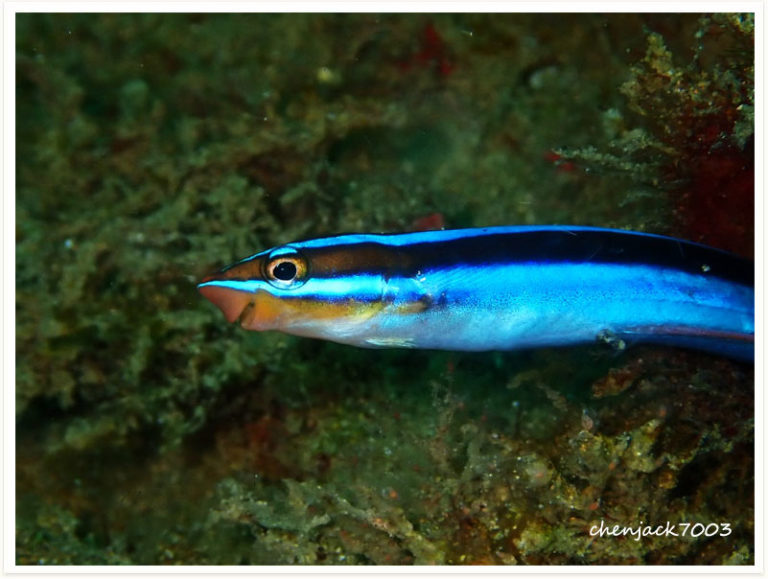
Plagiotremus rhinorhynchos, Bluestriped Blenny,Cleaner Mimic

Date: 2020/10/4Category: FishTag: white, brown, white

粗吻短带鳚、横口鳚、狗鲦

From before birth, their eggs are demersal and adhesive and attach to substrates via a filamentous adhesive pad or pedestal. The bluestriped fangblenny can attain around 90mm in length. Two distinct colour phases of this fish are present; blue with a black stripe from snout to tail, or orange with two narrow blue lines from snout to tail. Unlike most blennies, the bluestriped fangblenny is free swimming. Adults inhabit clear, coral-rich areas of lagoon and seaward reefs and it is fairly common on both coral and rocky reefs, usually occurring singly or in pairs.[citation needed] They are known for being aggressive and feed on skin, mucus and sometimes other fish scales. They bite divers when alarmed.

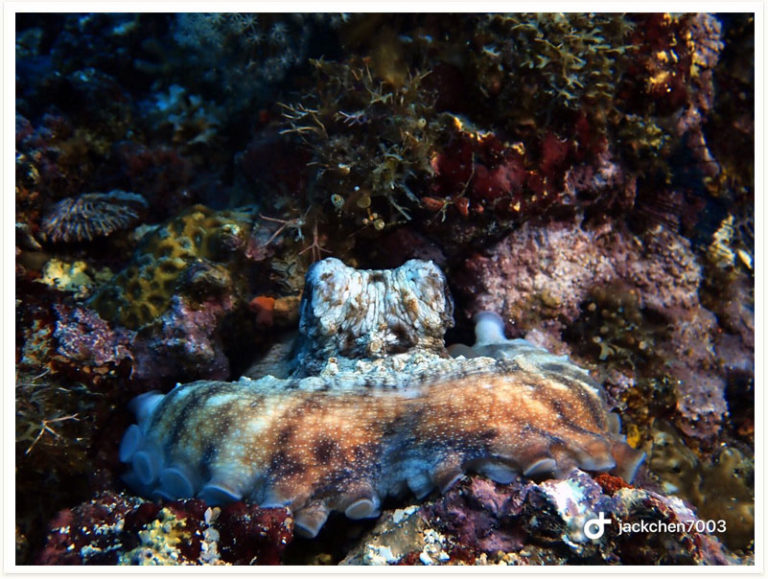
Octopus hummelincki,Bumblebee Octopus, Caribbean Two-Spot Octopus

Date: 2019/12/26Category: FishTag: white, brown

加勒比海双斑章鱼

unknow

Octopus hummelincki

Neotrygon kuhlii,Bluespotted Stingray

Date: 2019/12/25Category: FishTag: blue dots, brown

蓝斑魟鱼、 古氏魟

The bluespotted stingray has a flat disc-like rhomboid body up to 47 centimeters (19 in) in diameter and 70 centimeters (28 in) in total length.Their coloring is a dark green with blue spots with a light white underbelly also known as countershading. Its snout is very short and broadly angular along with its angular disc. The rays’ bright coloration serves as a warning for its venomous spines. The ray has a very long tail accommodating two venomous spines on the base of the tail. The tail is about twice as long as the body of the ray, and the barbs or spines are two different sizes, one being very large and the other a medium-sized barb. The bluespotted stingray has bright yellow eyes that are positioned to allow them a wide angle of view. Since the gills are located ventrally, the spiracles allow water to reach the gills while resting or feeding on the benthos. The spiracles are located directly behind the eyes. The mouth is located on the ventral side of the body, which promotes the unique foraging technique of stingrays. Rays are normally solitary individuals but can occur in groups. One unique characteristic of the bluespotted stingray is that they rarely bury themselves in the sand, only to hide from predators, unlike the majority of stingrays who bury themselves regularly to hunt.

Naso vlamingii,Big-nose Unicorn, Big-nose Unicornfish, Scribbled Unicornfish

Date: 2019/12/27Category: FishTag: brown, black, purple

丝尾鼻鱼、高鼻鱼、丝条盾尾鱼

This is a relatively large member of the Acanthuridae, easily reaching 60 centimeters. The adult has tall dorsal and anal fins, vertical blue lines on its sides, and small blue spots dorsally and ventrally. A broad blue band extends from the eyes to the prominent snout. The coloration of the juvenile is a dingy green with blue spots and lips, later turning deeper blue with purple markings. The fish turns mud-brown while sleeping or when frightened, a form of camouflage.

Metasepia pfefferi,Flamboyant Cuttlefish

Date: 2019/12/29Category: FishTag: white, brown, pink

火焰花枝 、 火焰墨鱼、火焰乌贼

M. pfefferi is a robust-looking species, having a very broad, oval mantle. Arms are broad and blade-like and have four rows of suckers. The modified arm used by males for fertilisation, called the hectocotylus, is borne on the left ventral arm. The oral surface of the modified region of the hectocotylus is wide, swollen, and fleshy. It bears transversely grooved ridges and a deep furrow running along the middle. The sucker-bearing surface of the tentacular clubs is flattened, with 5 or 6 suckers arranged in transverse rows. These suckers differ greatly in size, with the largest located near the centre of the club. Three to four median suckers are especially large, occupying most of middle portion of the club. The swimming keel of the club extends considerably near to the carpus. The dorsal and ventral protective membranes are not joined at the base of the club, but fused to the tentacular stalk. Dorsal and ventral membranes differ in length and extend near to the carpus along the stalk. The dorsal membrane forms a shallow cleft at the junction with the stalk. This particular species of cuttlefish is the only one known to walk upon the sea floor. Due to the small size of its cuttlebone, it can float only for a short time.

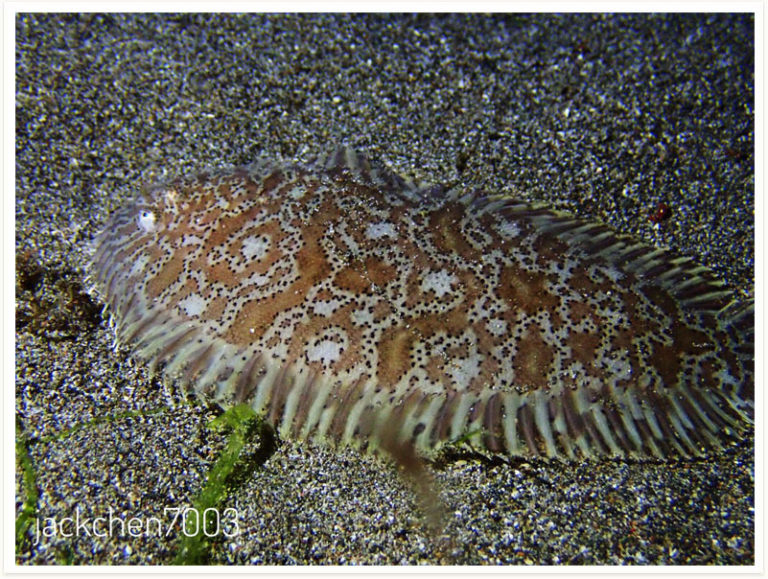
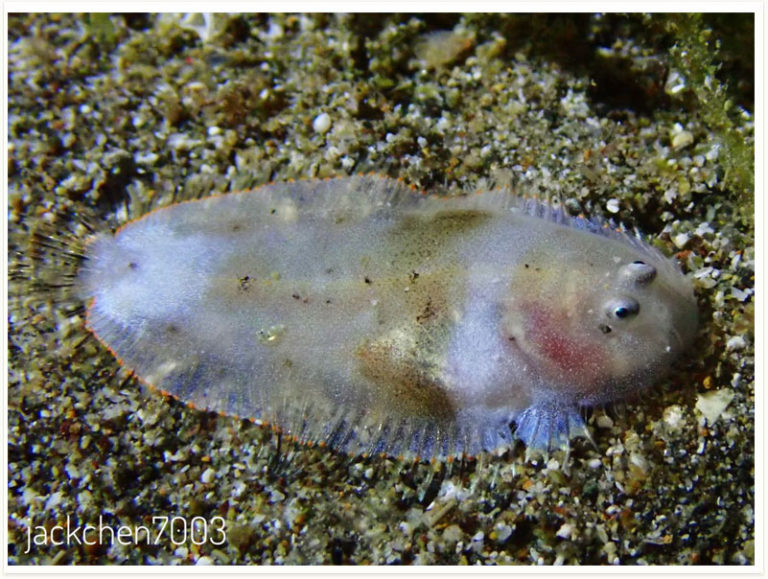
Liachirus melanospilos,Carpet Sole

Date: 2019/12/24Category: FishTag: white, brown

黑斑圆鳞鳎沙、 星点圆鳞鳎 ,龙舌、鳎沙、比目鱼

Liachirus is a genus of soles native to the Indian and western Pacific oceans.

Liachirus melanospilos Liachirus melanospilos

Lactoria cornuta,Longhorn Cowfish

Date: 2019/12/26Category: FishTag: brown, tatto, blue dots

角箱鲀、长牛角、箱河鲀、牛角、牛角狄

The longhorn cowfish (Lactoria cornuta), also called the horned boxfish, is a species of boxfish from the family Ostraciidae, recognizable by its long horns that protrude from the front of its head, rather like those of a cow or bull.They are a resident of the Indo-Pacific region and can grow up to 50 cm (20 in) long.

Heniochus chrysostomus,Horned Bannerfish, Horned Coralfish, Pennant Bannerfish, Threeband Pennant

Date: 2019/12/25Category: FishTag: white, black, brown

三带立旗鲷、金口马夫鱼,南洋关刀

The threeband pennantfish is a small-sized fish that can reach a maximum length of 18 cm.The body is laterally strongly flattened, with a basic white color and three broad oblique brown bands. The first dark brown band runs from the forehead up to the ventral fins, the second from the dorsal fin to the anal fin, the third is adjacent to the dorsal fin. The first rays of the dorsal fin is elongated and looks like a black and white feather.

Hapalochlaena lunulata, Greater Blue-ringed Octopus

Date: 2019/12/26Category: FishTag: blue, brown, poisonous

蓝环章鱼

The greater blue-ringed octopus is, despite its vernacular name, a small octopus whose size does not exceed 10 centimeters, arms included, for an average weight of 80 grams. Its common name comes from the relatively large size of its blue rings (7 to 8 millimeters in diameter), which are larger than those of other members of the genus and help to distinguish this type of octopus.The head is slightly flattened dorsoventrally and finished in a tip. Its eight arms are short.

Epinephelus fuscoguttatus,Brownmarbled Grouper,Flowery Rockcod

Date: 2020/6/29Category: FishTag: black, brown

褐点石斑鱼

Epinephelus fuscoguttatus is a medium-sized fish which grows up to 120 cm, but the average size mostly observed is 50 cm.Its body has a stocky and robust aspect, is compressed laterally and has a sharp profile for the head. The mouth is big and has a superior position with many small teeth and canine in front. The background coloration is pale yellowish-brown with many irregular in size and shape dark brown or Grey blotches. The body is also covered with many small dark brown spots. All the fins are large and round.

Dunckerocampus pessuliferus,Yellowbanded Pipefish

Date: 2019/12/24Category: FishTag: brown, yellow

带纹矛吻海龙、黑环海龙

Dunckerocampus pessuliferus (yellowbanded pipefish) is a species of marine fish of the family Syngnathidae. It is a coastal species, inhabiting waters around the Coral Triangle, including the Philippines, Indonesia, and northwestern Australia. It lives in coral patches on sandy and muddy slopes at depths of 15–44 metres (49–144 ft), where it can grow to lengths of 16 centimetres (6.3 in). It is an active cleaner, feeding off of parasitic crustaceans growing on other fishes. The adult fish form pairs and are normally observed swimming along the bottom around large remote coral heads on muddy slopes. This species is ovoviviparous, with males carrying eggs and giving birth to live young

Diodon liturosus,Black-blotched Porcupinefish

Date: 2019/12/27Category: FishTag: yellow, black, brown

布氏刺鲀

The Black-blotched porcupinefish is a medium-sized fish which grows up to 65 cm (26 in), but the average size most likely to be observed is 45 cm (18 in). Its body is elongated with a spherical head with big round protruding eyes and a large mouth that is rarely closed. The pectoral fins are large, the pelvic fins are absent, the anal and dorsal fins are close to the caudal peduncle. The latter move simultaneously during swimming. All fins are a uniform tint of white or yellowish without any spotting. The skin is smooth and firm, the scales are modified into spines directed towards the back. The body coloration is light brown to sandy-yellowwith dark blotches circled with a white line and pale ventral surface. The only other fish with which it might be confused is the long-spine porcupinefish, (Diodon holocanthus) but it has much shorter spines and it lacks a dark streak running between the eyes.

Diodon holocanthus,Long-spine Porcupinefish

Date: 2019/12/24Category: FishTag: brown

六斑二齿鲀、刺龟、刺规、刺乖

The long-spine porcupinefish is pale in colour with large black blotches and smaller black spots; these spots becoming fewer in number with age. It has many long, two-rooted depressible spines particularly on its head. The teeth of the two jaws are fused into a parrot-like “beak”. Adults may reach 50 cm (20 in) in length. The only other fish with which it might be confused is the black-blotched porcupinefish (Diodon liturosus), but it has much longer spines than that species.

Dendrochirus zebra,Zebra Lionfish,Dwarf Lionfish,Zebra Turkeyfish

Date: 2019/12/25Category: FishTag: white, red, brown

花斑短狮子鱼,花斑短鳍蓑鲉,斑马纹多臂蓑鲉

The zebra turkeyfish is an unusual looking fish with vertical stripes in orange, white and black on the body, and large, banded fan-like pectoral fins that flare out on either side as the fish lies on the seabed. The front dorsal fin is made up of thirteen tall, quill-like spines and the second dorsal fin has ten to eleven soft rays. The anal fin has three spines and about ten soft rays. The second dorsal fin, the anal fin and the rounded caudal fin are transversely banded in black and white. This fish grows to a maximum length of about 25 cm (10 in).

Dactyloptena orientalis,Flying Gurnard, Helmet Gurnard , Oriental Flying

Date: 2019/12/25Category: FishTag: brown, black dots

东方豹鲂鮄、蜻蜒角、盖丝文、飞龟鱼、飞虎、飞角鱼

The oriental flying gurnard can grow to 40 cm (16 in) in length but its common size is about 20 cm (8 in). It has a broad head with a blunt snout and the eyes are set a long way apart. It has a heavily armoured robust body. The dorsal fin has seven spines and nine soft rays while the anal fin has no spines and six to seven soft rays. The huge, rounded pectoral fins having many dark spots and wavy streaks and a bright blue edge. Each ray has a feeler-like extension on the tip. This fish is well camouflaged with a grayish brown base color with dark brown or black markings on its head and body.

Cymbacephalus beauforti,Crocodile Fish

Date: 2019/12/25Category: FishTag: brown

博氏孔牛尾鱼、 博氏孔鲬、竹甲、狗祈仔、牛尾

The Crocodilefish is a medium-sized fish which grows up to 50 cm (19.7 in), but the average size mostly observed is 35 cm (13.8 in).[1] The body is elongated and the head is particular because of its flat appearance like a duck bill. They have lappets at the rear of their globulous eyes, which help to break up the outline of the black iris and improve their camouflage. Juveniles begin black with few white spots and a white line behind the head. The adults have a body coloration which can vary in intensity according to the surrounding. The body is covered with a pattern like a mosaic of beige to brown spots or even greenish to grey separated by an interlacing of blue lines which ideally camouflaged them with their habitat.

Cyclichthys orbicularis,Birdbeak Burrfish

Date: 2019/12/24Category: FishTag: brown

圆点短刺鲀、 短棘圆刺鲀、刺规、气瓜仔、圆点圆刺鲀

Cyclichthys orbicularis, known commonly as the Birdbeak burrfish among other vernacular names, is a species of marine fish in the family Diodontidae.

The Birdbeak burrfish is widespread throughout the tropical waters of the Indo-West Pacific region from Red Sea to the Philippines.

Cromileptes altivelis,Humpback Grouper

Date: 2019/12/25Category: FishTag: brown, black dots

驼背鲈、老鼠斑,青斑

The humpback grouper is a medium-sized fish which grows up to 70 cm (28 in). Its particular body shape makes this grouper quite impossible to mix up with other fishes. Its body is compressed laterally and is relatively high. This stocky and strange visual effect is accented by its concave profile and its elongated snout which gives it a humpbacked appearance.

Corythoichthys haematopterus,Messmate Pipefish,Yello-banded Pipefish

Date: 2019/12/24Category: FishTag: brown

红鳍冠海龙、 红鳍海龙,黄带冠海龙

The messmate pipefish (Corythoichthys haematopterus) is a species of marine fish in the family Syngnathidae. It is widespread throughout the tropical waters of the Indo-Pacific region, from the eastern coast of Africa to the Vanuatu Islands. This species can reach a length of 19.8 cm.It occasionally makes its way into the aquarium trade where it is known as the dragonfaced pipefish.Other common names are bloodspot pipefish, reef pipefish, reeftop pipefish and yellow-streaked pipefish.

Cirrhitichthys aprinus,Blotched Hawkfish,Red Barred Hawkfish,Threadfin Hawkfish

Date: 2019/12/26Category: FishTag: white, pink, brown

斑金䱵、短嘴格

The spotted hawkfish, Cirrhitichthys aprinus is a species of hawkfish widespread throughout the tropical waters of the Indo-West Pacific region.A common species, it is found in rocky and coral areas of subtidal coastal reefs.

It can reach a maximum length of 12.5 cm (4.9 in). It is a food fish for indigenous peoples and can also be found in the aquarium trade. It is red-pink and white in color, and has tassels on the tip of its dorsal fin.

Chelonia mydas,Green Sea Turtle

Date: 2019/12/26Category: FishTag: green, black, brown

绿蠵龟、青海龟

The green sea turtle (Chelonia mydas), also known as the green turtle, black (sea) turtle or Pacific green turtle, is a species of large sea turtle of the family Cheloniidae. It is the only species in the genus Chelonia. Its range extends throughout tropical and subtropical seas around the world, with two distinct populations in the Atlantic and Pacific Oceans, but it is also found in the Indian Ocean.The common name refers to the usually green fat found beneath its carapace, not to the color of its carapace, which is olive to black.

Cheilinus undulatus,Hump-headed Wrasse,Napoleon Wrasse,Giant Wrasse

Date: 2019/12/26Category: FishTag: black, brown, white

曲纹唇鱼、苏眉鱼,拿破仑鱼、龙王鲷、海哥龙王、大片仔

The humphead wrasse is the largest living member of the family Labridae. Males are typically larger than females and are capable of reaching lengths of up to 2 meters from tip to tail and weighing up to 180 kg, but the average length is generally a little less than 1 meter. Females rarely grow larger than one meter in length. This species of fish can be easily identified by its large size, thick lips, two black lines behind its eyes, and the hump that appears on the forehead of larger adults. The color of the humphead wrasse can vary between a dull blue-green to more vibrant shades of green and purplish-blue. This particular reef fish prefers to live singly but adults are occasionally observed moving in small groups.

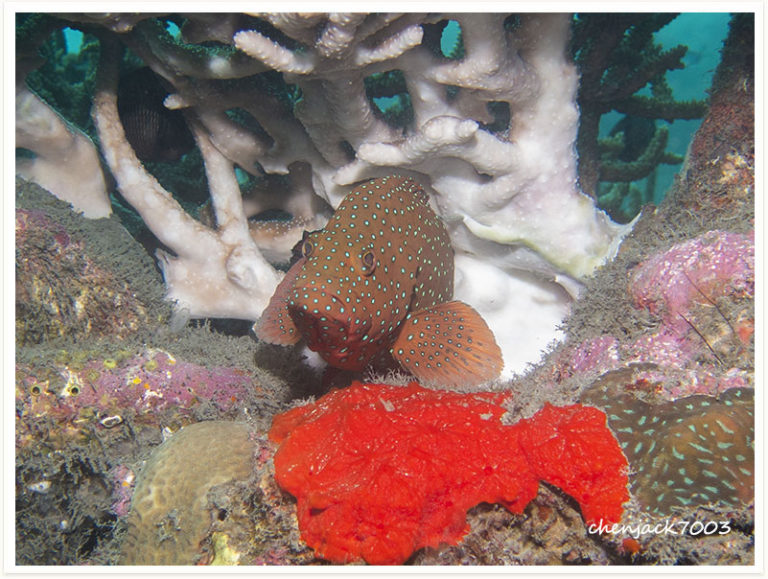
Cephalopholis cyanostigma,Bluespotted Hind

Date: 2020/6/29Category: FishTag: brown, green dosts

蓝点九棘鲈

A brown to reddish-brown rockcod, covered in bluish to cream spots, and often with mottling and several pale bars on the sides. Juveniles are bluish-grey to brownish with yellow fins (except pectoral fins).

Cephalopholis cyanostigma

Cephalopholis argus,Peacock Grouper

Date: 2019/12/25Category: FishTag: brown, blue dots

斑点九棘鲈、 斑点九刺鮨、眼斑鲙

This is a medium-sized fish that can reach a length of 60 centimeters (24 in). Small individuals are dark brown with hundreds of small, dark-edged iridescent blue spots. Larger specimens sometimes develop four to six lighter vertical bars on the back half of its body.

Callistoctopus macropus,White-spotted Octopus

Date: 2019/12/26Category: FishTag: brown

大西洋白斑章鱼,白斑章鱼,草章鱼、草天窗

Callistoctopus macropus grows to a mantle length of 20 cm (8 in) with a total length of 150 cm (59 in). The first pair of arms are a metre or so long, and are much longer than the remaining three pairs. The arms are all connected by a shallow web. This octopus is red, with white blotches on its body, and paired white spots on its arms. When it is disturbed, its colour becomes more intense, deimatic behaviour which may make it appear threatening to a potential predator.

Bryaninops yongei,Whip Coral Goby

Date: 2020/7/30Category: FishTag: transparent, brown, tiny

勇氏珊瑚虾虎鱼 、 颏突珊瑚虾虎鱼

The whip coral goby has a semi-transparent head and body, with white scales running along its vertebra. Its head is reddish-brown to violet in color and the goby has pink to violet-red eyes. Their coloration is noted to match the color of the coral they inhabit. The fish is approximately 3 to 3.5 centimeters long. Healthy whip coral gobies have seven dorsal spines, seven dorsal soft rays, one anal spine and seven anal soft rays. They also have cup-like pelvic fins and gills that open below the base of the pectoral fins.

Bryaninops amplus,Large Whip Goby

Date: 2019/12/24Category: FishTag: transparent, brown

狭鳃珊瑚鰕虎鱼

Bryaninops amplus, known commonly as the large whip goby or white-line seawhip goby, is a species of marine fish in the family Gobiidae.

The white-line seawhip goby is widespread throughout the tropical waters of the Indo-Pacific area, including Hawaii but not the Red Sea.

Bodianus dictynna,Redfin Hogfish

Date: 2020/9/26Category: FishTag: white, brown

网纹普提鱼、网纹狐鲷

Bodianus dictynna, is a species of wrasse native to tropical and warm temperate waters of the Western Pacific, from the Indo-Malaysian Archipelago east to Tonga, as far north as Japan and as far south as Australia. It is most frequently recorded in association with living coral reefs and the juvenile fish usually occur near black coral and gorgonians, although they sometimes are found in caves near the ceiling. It feeds mainly on benthic invertebrates such as molluscs and crustaceans. The juveniles regularly behave as cleaner fish, removing parasites from other fish. The specific name dictynna is an alternative name for Diana, the Roman goddess of hunting, and refers to the close relationship between this species and Bodianus diana of the Indian Ocean, and a proposed common name of Pacific Diana’s pigfish also reflects this relationship.

Aulostomus chinensis,Pacific Trumpetfish,Chinese Trumpetfish

Date: 2019/12/24Category: FishTag: yellow, brown

中华管口鱼、 海龙须、牛鞭、篦箭柄

Aulostomus chinensis is a medium-sized fish which grows up to 80 cm in length. Its body is elongated and compressed laterally, with a long, tubular snout which has a small barbel at its inferior extremity. The protusible mouth can be extended forward to catch prey. On the top posterior part of the body, the dorsal fin is composed of two parts, the first anterior is a set of isolated spines and the second is a small ray fin. This latter fin is similar in shape to the anal fin which is just under. The pelvic fins are located in the middle of the body and are small, with one basal black spot.

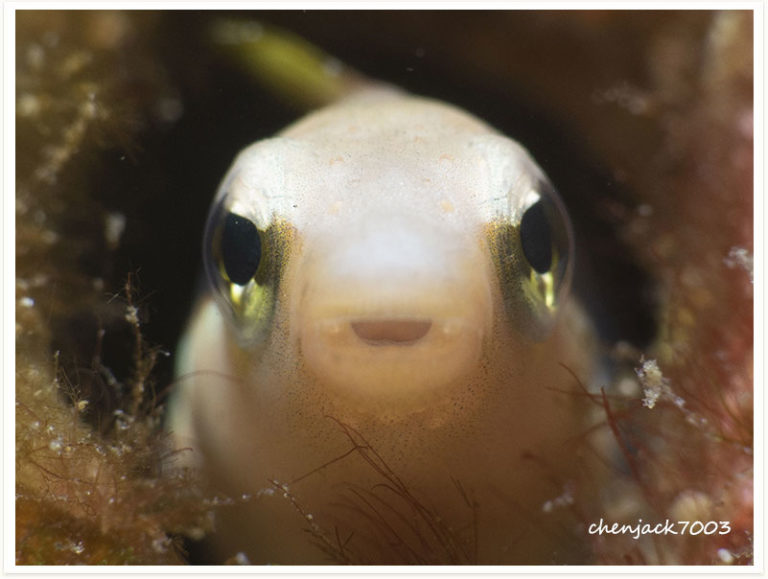
Aspidontus dussumieri,Dussumier’s Blenny, Lance Blenny

Date: 2019/12/25Category: FishTag: white, blue, brown

稻氏盾齿鳚、稻氏盾齿鳚丝尾盾齿鳚,丝尾盾齿鳚

Aspidontus dussumieri, the lance blenny or Dussumier’s blenny, is a species of combtooth blenny found in coral reefs in the Pacific and Indian Oceans.The specific name honours the French explorer and merchant Jean-Jacques Dussumier (1792-1883).

Aspidontus dussumieri Aspidontus dussumieri Aspidontus dussumieri

Arothron mappa,Map Puffer

Date: 2019/12/27Category: FishTag: black, brown, tatto

条纹叉鼻鲀

Arothron mappa is a medium sized fish which grows up to 65 cm length. Its body is oval shape, spherical yet relatively elongated. The skin is not covered with scales. The fish has no pelvic fin and no lateral line. The dorsal fin and the anal fin are small, symmetric and located at the end of the body. Its snout is short with two pairs of nostrils and its mouth is terminal with four strong teeth.

Arothron hispidus,White-spotted Puffer

Date: 2020/6/12Category: FishTag: brown, white dots

纹腹叉鼻鲀、白点河鲀、乌规、花规、绵规

The white-spotted puffer (Arothron hispidus) is a medium to large-sized puffer fish, it can reach 50 cm length. It is light grey in color, or greyish or yellowish, and clearly covered with more or less regular white points, that become concentric contrasting white and dark grey lines that radiate around the eyes and pectoral fins. The ventral part is white. The “shoulder” (around the pectoral fins) is dark. It also has concentric contrasting white and dark grey lines that radiate around the eyes and pectoral fins.

Arothron caeruleopunctatus ,Blue-spotted Puffer

Date: 2019/12/27Category: FishTag: white, blue, brown, blue dots

青斑叉鼻鲀、蓝点叉鼻鲀、气规、规仔

Arothron caeruleopunctatus is a medium-sized fish which grows up to 80 cm length. Its body is oval shape, spherical et relatively elongated. The skin is not covered with scales. The fish has no pelvic fin and no lateral line. The dorsal fin and the anal fin are small, symmetric and located at the end of the body. Its snout is short with two pairs of nostrils and its mouth is terminal with four strong teeth.

Amblypomacentrus breviceps,Black-banded Demoiselle

Date: 2019/12/24Category: FishTag: white, brown

短头钝雀鲷、 厚壳仔

It’s a small size fish that can reach a maximum size of 8,5 cm length.

Amblypomacentrus breviceps

Ablabys taenianotus,Cockatoo Waspfish

Date: 2019/12/27Category: FishTag: brown, white

帆鳍鲉、背带长绒鲉、钝顶鲉、济公

This fish can be up to 6 inches (15 cm) in length. The body compressed laterally, endowed with a dorsal fin starting from the top of the head until joining practically the superior base of the caudal fin. When the dorsal fin is spread, it looks like a crest resembling the one on a cockatoo. The thorns of the dorsal fin are venomous. This fish mostly stays on the substratum and moves by means of its pectoral fins. Its color varies from cream to dark brown, with irregular spots.

Ablabys macracanthus

Date: 2019/12/25Category: FishTag: brown

济公鱼、长棘长绒鲉、大棘帆鳍鲉、狮子鱼、黑虎

Ablabys macracanthus, also known as the spiny waspfish or as the spiny leaf-fish in Indonesia, is a Waspfish of the genus Ablabys that inhabits the Western Pacific and Indian Oceans.

The spiny waspfish is a primarily reef-dwelling fish, living at a depth of 1 to 20 meters below the surface.It lives at tropical latitudes (25 to 8 degrees north latitude).

Thenus orientalis,Flathead Lobster,Slipper Lobster

Date: 2019/12/17Category: LobsterTag: orange, red, brown

东方扁虾,琵琶虾

Thenus orientalis is a species of slipper lobster from the Indian and Pacific oceans.

T. orientalis is known by a number of common names. The United Nations’ Food and Agriculture Organization prefers the name flathead lobster, while the official Australian name is Bay lobster. In Australia, it is more widely known as the Moreton Bay bug after Moreton Bay, near Brisbane, Queensland. In Singapore, both the flathead lobster and true crayfish are called crayfish. They are used in many Singaporean dishes. The species is sometimes confused with the Balmain bug (Ibacus peronii) but it can be distinguished by the placement of the eyes: the eyes of I. peronii are near the midline, while those of T. orientalis are at the margin of the carapace.

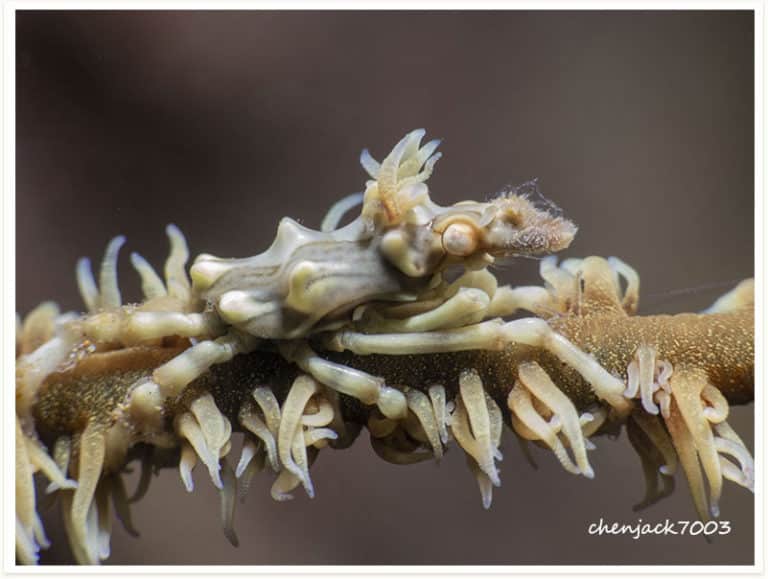
Xenocarcinus tuberculatus,Wire Coral Crab

Date: 2020/10/1Category: CrabTag: brown

线珊瑚蟹

Xenocarcinus tuberculatus is een krabbensoort uit de familie van de Epialtidae. De wetenschappelijke naam van de soort is voor het eerst geldig gepubliceerd in 1847 door White.

Xenocarcinus tuberculatus

Porcellanella haigae,Haig’s Porcelain Crab, Sea-pen Crab

Date: 2019/12/17Category: CrabTag: brown

海笔陶瓷蟹

Porcellanella haigae is een tienpotigensoort uit de familie van de Porcellanidae. De wetenschappelijke naam van de soort is voor het eerst geldig gepubliceerd in 1963 door Sankarankutty.

Porcellanella haigae

Macropodia longirostris,Spider Crab

Date: 2020/11/12Category: CrabTag: brown

蜘蛛蟹

Macropodia is a genus of crabs, belonging to the family Inachidae.

Macropodia longirostris

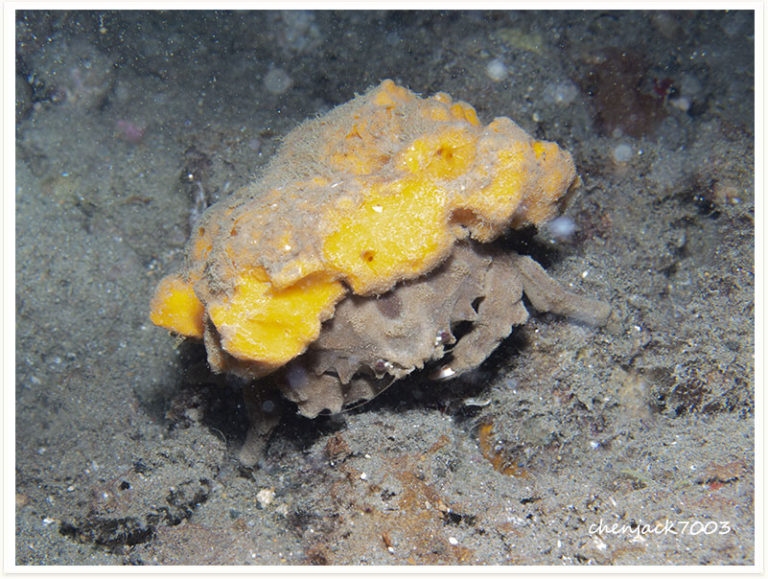
Lewindromia unidentata,Sponge Crab

Date: 2020/8/4Category: CrabTag: yellow, brown

海绵蟹

With shelters on caps of sponges, ascidians, actinians or colonial cnidarians.

Lewindromia unidentata

Dorippe frascone,Urchin Crab,Carrier Crab

Date: 2020/5/23Category: CrabTag: brown

疣面关公蟹

The urchin crab is a brownish-pink colour and grows to a length of about 5 cm . It has long-stalked eyes, a rounded carapace and long, slender legs. It uses only the first two pairs of legs for locomotion because the third and fourth pairs are used to grip a sea urchin which it carries around on its back. It is similar in morphology to the jellyfish crab (Ethusa spp.) but is easily distinguished by the different invertebrate transported. It also resembles decorator crabs[2] but those actually stick living creatures such as sponges, hydroids and bryozoans, bits of algae and inert objects to their shells.

Camposcia retusa,Decorator Crab

Date: 2019/12/17Category: CrabTag: brown

钝额曲毛蟹

Camposcia retusa, known commonly as the spider decorator crab, is a species of marine crustacea in the family Inachidae.

The spider decorator crab is widespread throughout the tropical waters of the Indo-West Pacific area, including the Red Sea.

This crab has a shell size of 3 cm and with the legs it can reach 10 cm.

Achaeus japonicus,Orangutan Crab

Date: 2019/12/17Category: CrabTag: red, brown

大猩猩蟹、 日本英雄蟹

Achaeus japonicus, sometimes known as the orang-utan crab, is a crab of the family Inachidae (spider crabs or decorator crabs) which can be observed in tropical waters of the central Indo-Pacific.

With a carapace of only about 2 centimetres or 0.8 inches in diameter, it has relatively long arms, which are thickly covered with fine hairs, red or reddish brown in colour, and often laden with small bits of debris for further camouflage. It is frequently, but not always, found in association with the bubble coral Plerogyra sinuosa.

Xestospongia testudinaria,Barrel Sponge

Date: 2019/12/27Category: CoralTag: brown

锉海绵属海绵

This species is maroon to pink, with the opening of the barrel pale white.

Specimens are often found emerging from an apparent common base. In the intertidal zones, this species ranges from 10 to 20 cm in diameter, and are about 10 to 20 cm tall.

A bioactive peptide consisting of 13 amino acids, KENPVLSLVNGMF, has been identified from this species. The peptide was selectively toxic to human cervical cancer cells (HeLa), but non-toxic to non-cancerous, human embryonic kidney cell line (HEK 293 cells).

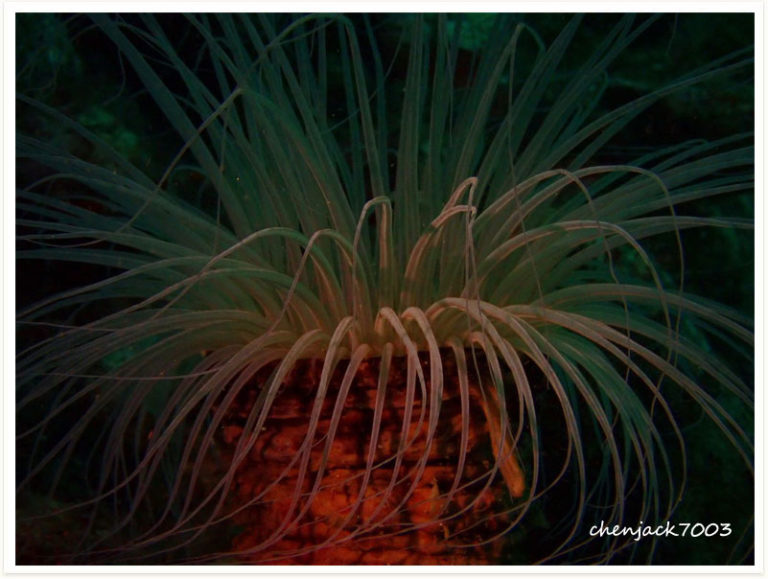
Pachycerianthus longistriatus,Striped Tube Anemone, Striated Tube

Date: 2019/12/27Category: CoralTag: white, brown

条纹管海葵

Pachycerianthus is a genus of marine tube-dwelling anemones in the family Cerianthidae.

Pachycerianthus longistriatus

Oceanapia sagittaria,Pink Puff Ball Sponge, Maiden’s Fans Sponges

Date: 2019/12/27Category: CoralTag: pink, brown

粉色球海绵

Small delicate prickly ball about 1-2cm in diameter, on a short conical stem (called the capitate structure). The ball has fine sheets between the prickles. Seen singly but sometimes a few seen near one another growing on coral rubble. This puffy fluff is just a tiny part of the sponge. The bulk of the sponge is actually buried! The main sponge is bulbous and spherical. Colour usually a deep maroon to bright pink.

Ianthella basta,Elephant Ear Sponge, Paper Sponge

Date: 2019/12/27Category: CoralTag: yellow, blue, brown

大象耳海绵

Ianthella basta, commonly known as elephant ear sponge, is a species of fan-shaped sea sponge in the class Demospongiae. It is also known as the paper sponge or scroll sponge.

Sponges are marine invertebrates with a jellylike mesohyl sandwiched between two layers of cells. They are filter feeders maintaining a flow of water through their structure which passes out through large openings called oscula. They have a fragile skeleton of stiff spicules.

Goniopora sp01

Date: 2020/2/17Category: CoralTag: white, brown

柱形管孔珊瑚

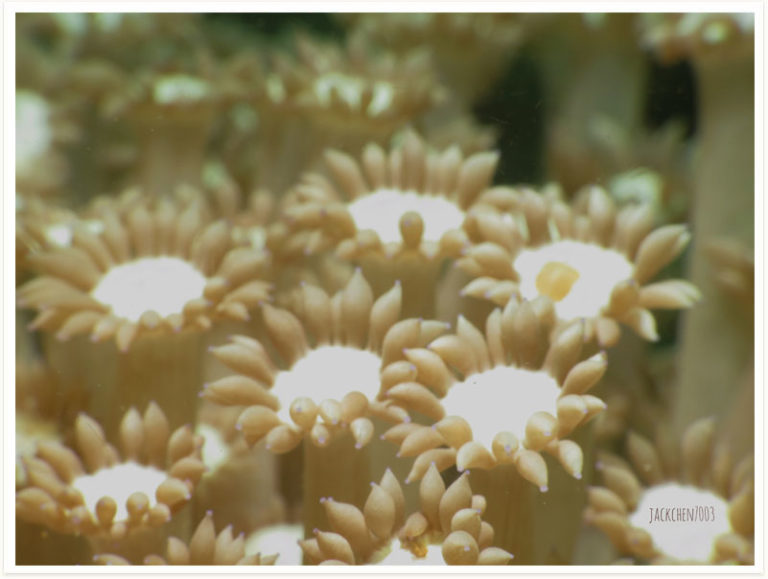
Goniopora, often called flowerpot coral, is a genus of colonial stony coral found in lagoons and turbid water conditions. Goniopora have numerous daisy-like polyps that extend outward from the base, each tipped with 24 stinging tentacles which surrounds a mouth.

Goniopora sp01

Fimbriaphyllia ancora,Anchor Coral Hammer Coral

Date: 2019/12/27Category: CoralTag: white, brown

腰子海葵

This type of madreporial colony is easy to identify because of its puffy tubular tentacles with T-shaped tips. The coral is blue-gray to orange in color, sometimes with green on the tentacles. It can demonstrate full or partial viral infection of green fluorescent protein, a trait highly sought for aquarium specimens. Colonies are usually no more than a meter across, but at times can reach several meters.

Amplexidiscus fenestrafer, Giant Elephant Ear,Giant Cup Mushroom

Date: 2020/8/21Category: CoralTag: white, brown

象耳海葵

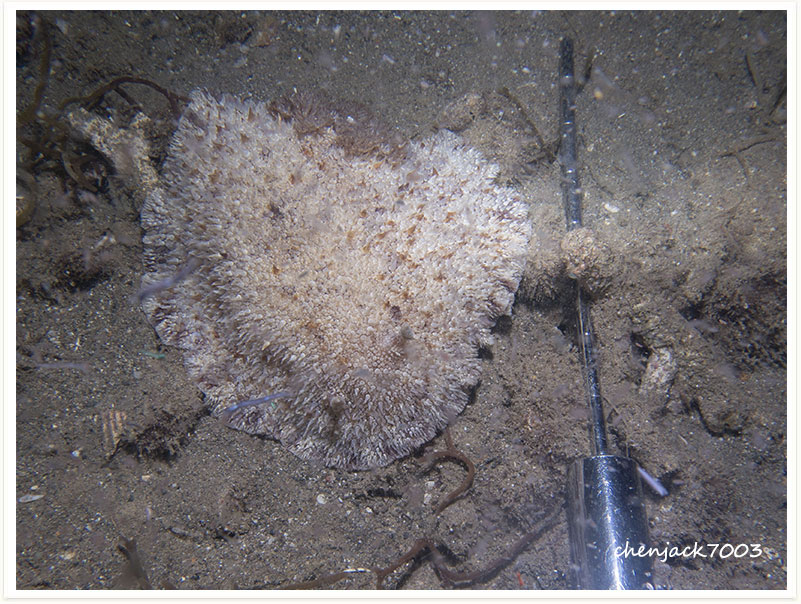
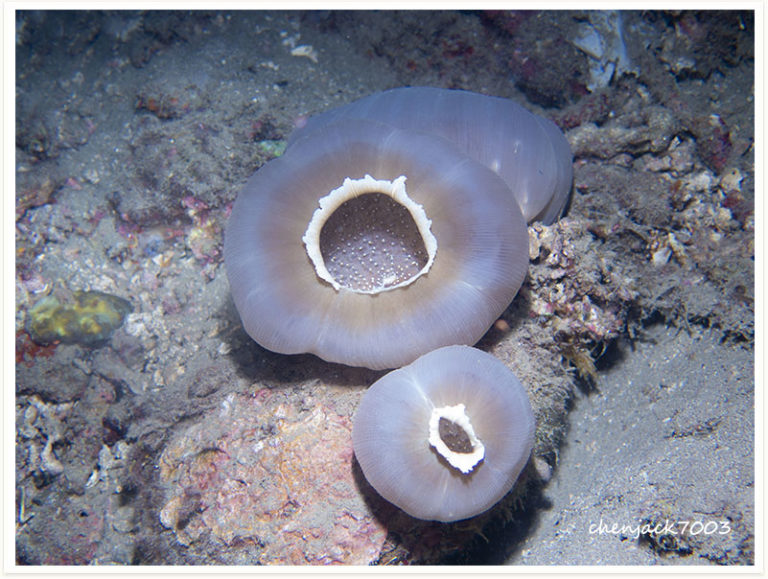
The visible part of its body corresponds to its oral region and forms a flexible disc, when it is deployed, endowed with cone-shaped tentacles. Its diameter can reach 40 centimetres (16 in) and its coloration is light beige to brown.

Amplexidiscus fenestrafer