Underwater PhotographyUnderwater Photography
Home
Article
Category
Tag
Timeline
About
Home
Article
Category
Tag
Timeline
About
white 194brown 86blue 55black 111yellow 111pink 26transparent 33orange 62green 43purple 33red 44colorful 35brwon 50white dots 8yellow dots 6zebra 1silvery 9gray 15blue dots 12big 13tatto 12black dots 14green dots 1tiny 25green dosts 1bronw 3poisonous 2blue-border 1purple-border 1black margin 1black-dots 1color 1red dots 1yellow-rhinophores 1white-border 1purple-striped 1lightpink 1red-dot 1white striped 2leopard-print 1light pink 1
Odontodactylus cultrifer,Pastel Odontodactylid Mantis Shrimp

Date: 2019/12/16Category: ShrimpTag: silvery

脊尾齿指虾蛄

Odontodactylus is a genus of mantis shrimp, the only genus in the family Odontodactylidae. Mantis shrimp of the genus Odontodactylus can not only detect circular polarisation of light, but can also detect polarise light reflecting off their telson and uropods.
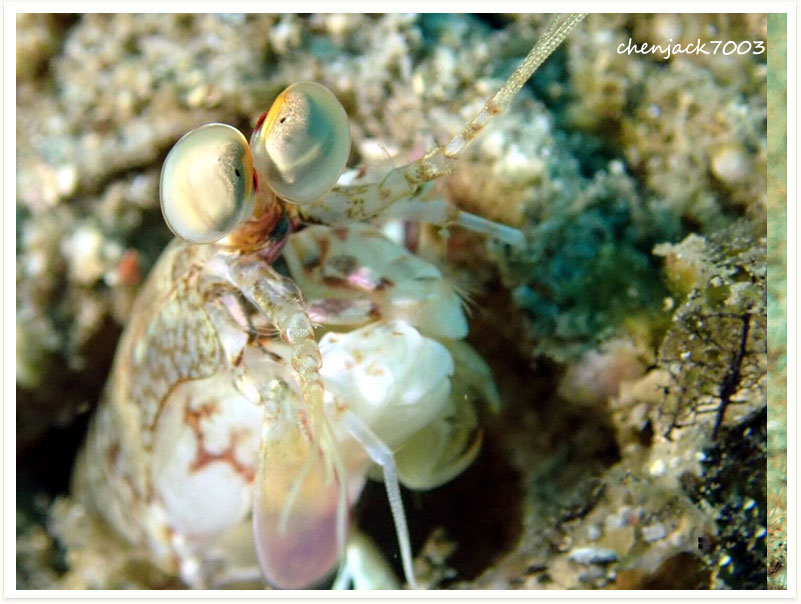
Odontodactylus cultrifer

Sphyraena putnamae,Sawtooth Barracuda

Date: 2019/12/26Category: FishTag: silvery

倒牙魣、布氏金梭鱼,针梭、竹梭、巴拉库答

This fish has a torpedo-shaped extension, a cylindrical cross-section near, the bottom of the maxillary front edge, to the side of the body 20 having a triangular pattern, extending from the back side to about 2/3 of the bottom line, a first fin group anal bone there expanding phenomenon. 6 dorsal spines; soft dorsal section 9; anal spines 2; Anal soft rays 7-9 pieces, up to 90 cm in length.

Platax teira,Longfin Batfish,Tiera Batfish,Spotbelly Batfish

Date: 2019/12/24Category: FishTag: silvery, yellow, black

尖翅燕鱼

Platax teira has a dark blotch under the pectoral fin, with another long dark mark above the base of the anal fin. Looked at from the side, it has a roughly circular body with a low hump on the nape. This fish is usually silver, grey or brownish. It has a blackish band through the eye and another band with the pectoral fin. They will change colour from silvery white with no bands, to brown with darker banding as you watch, and then fade back to silver again.

Gymnosarda unicolor,Dogtooth Tuna

Date: 2019/12/26Category: FishTag: silvery

裸狐鲣、裸䲠,长翼

The dogtooth tuna can reach a length of 190–248 centimetres (75–98 in) in males. and a weight of 130 kg. The average size commonly observed is around 40 to 120 cm. They have 12-14 dorsal soft rays and 12-13 anal soft rays. The lateral line is strongly undulating. These large size tunas have a streamline shape and a distinctive body coloration: brilliant blue green on the back, silvery on the side and whitish on the belly, with two white tips on the two back fins close to its caudal peduncle. They are always swimming with open jaws. The upper jaw of the large mouth reaches the eye.

Fistularia commersonii,Bluespotted Cornetfish

Date: 2019/12/25Category: FishTag: silvery, green

棘烟管鱼、无鳞烟管鱼、棘马鞭鱼、康氏马鞭鱼

It is widespread in the tropical and subtropical waters of the Indo-Pacific as far north as Japan and east to the coasts of the Americas, including the Red Sea. In 2000, its presence was reported in the Mediterranean Sea; since then, it has continued to disperse and is now well established in some areas. This species is considered as part of the Lessepsian migration. It has spread rapidly through the Mediterranean from its origin in the Suez Canal, the first records being off Israel in 2000 and it had reached the southern coast of Spain and as far north as the Gulf of Lions by 2007.Scientists have determined that the fish in the Mediterranean are all descended from a small number of ancestors, possibly as a result of a single invasion event, and are not as genetically variable as their conspecifics in the Red Sea.

Caranx melampygus,Bluefin Trevally

Date: 2019/12/25Category: FishTag: white, blue, silvery

蓝鳍鲹、黑尻鲹、黄臂鲹,甘仔鱼

The bluefin trevally is a large fish, growing to a maximum known length of 117 cm and a weight of 43.5 kg, however it is rare at lengths greater than 80 cm. It is similar in shape to a number of other large jacks and trevallies, having an oblong, compressed body with the dorsal profile slightly more convex than the ventral profile, particularly anteriorly. This slight convexity leads to the species having a much more pointed snout than most other members of Caranx. The dorsal fin is in two parts, the first consisting of 8 spines and the second of 1 spine followed by 21 to 24 soft rays. The anal fin consists of 2 anteriorly detached spines followed by 1 spine and 17 to 20 soft rays.The pelvic fins contain 1 spine and 20 soft rays.The caudal fin is strongly forked, and the pectoral fins are falcate, being longer than the length of the head. The lateral line has a pronounced and moderately long anterior arch, with the curved section intersecting the straight section below the lobe of the second dorsal fin. The curved section of the lateral line contains 55-70 scales while the straight section contains 0 to 10 scales followed by 27 to 42 strong scutes. The chest is completely covered in scales. The upper jaw contains a series of strong outer canines with an inner band of smaller teeth, while the lower jaw contains a single row of widely spaced conical teeth. The species has 25 to 29 gill rakers in total and there are 24 vertebrae present.The eye is covered by a moderately weakly developed adipose eyelid, and the posterior extremity of the jaw is vertically under or just past the anterior margin of the eye.Despite their wide range, the only geographical variation in the species is the depth of the body in smaller specimens.

Caranx lugubris,Black Jack

Date: 2019/12/26Category: FishTag: silvery

阔步鲹、黑鲹、甘仔鱼

Caranx lugubris, the black jack, black trevally, black kingfish, coal fish or black ulua, is a species of large ocean fish in the jack family Carangidae. The species has a circumtropical distribution, found in oceanic, offshore waters of the tropical zones of the Pacific, Atlantic and Indian Oceans. The species is particularly prevalent around offshore islands such as the Caribbean islands in the Atlantic, Hawaii and French Polynesia in the Pacific and the Seychelles and Maldives in the Indian Ocean. Black jack are rare in shallow waters, preferring deep reefs, ledges and seamounts in clear waters. The species is easily distinguished by its black to grey fins and jet black scutes, with the head having a steep profile near the snout. The largest recorded length is 1 m and weight of 17.9 kg. The black jack lives either individually or in small schools, and is known to school with other species. It is a predatory fish, taking a variety of fish, crustaceans and molluscs as prey. Sexual maturity is reached at 34.6 cm in females and 38.2 cm in males, with spawning taking place between February and September in the Caribbean. The early life history of the species is very poorly understood. Black jack are of high importance to many island fisheries, but are rarely encountered in most continental fisheries. The species has a reputation as a gamefish, and is variably considered a terrible or excellent food fish, although several cases of ciguatera poisoning have been attributed to the species. The species was initially named Caranx ascensionis by Georges Cuvier, however several issues with the use of this name have seen Felipe Poey’s name Caranx lugubris become the valid scientific name.

Caranx ignobilis,Giant Trevally

Date: 2019/12/25Category: FishTag: silvery, black

珍鲹、白面弄鱼、浪人鲹、牛港鲹、牛港瓜仔、牛公瓜仔、流氓瓜仔

The giant trevally is the largest member of the genus Caranx, and the fifth-largest member of the family Carangidae (exceeded by the yellowtail amberjack, greater amberjack, leerfish and rainbow runner), with a recorded maximum length of 170 cm and a weight of 80 kg. Specimens this size are very rare, with the species only occasionally seen at lengths greater than 80 cm. It appears the Hawaiian Islands contain the largest fish, where individuals over 100 lbs are common. Elsewhere in the world, only three individuals over 100 lbs have been reported to the IGFA.

Alopias vulpinus, Thresher Shark

Date: 2019/12/25Category: FishTag: silvery

细尾长尾鲨、狐形长尾鲨、狐鲛

The common thresher is a fairly robust shark with a torpedo-shaped trunk and a short, broad head. The dorsal profile of the head curves evenly down to the pointed, conical snout. The eyes are moderately large and lack nictitating membranes. The small mouth is arched and, unlike in other thresher sharks, has furrows at the corners. The species has 32-53 upper and 25-50 lower tooth rows; the teeth are small, triangular, and smooth-edged, lacking lateral cusplets. The five pairs of gill slits are short, with the fourth and fifth pairs located over the pectoral fin bases.